
More than 60 percent of British businesses are now exploring flexible web solutions that offer greater freedom than traditional websites. In today’s fast-paced digital world, leaders want platforms that adapt quickly to new technologies and changing needs. Understanding headless websites can help British companies stay ahead, offering new possibilities for designers and developers without the limits of standard systems.
Table of Contents
- What Is A Headless Website? Core Definition
- How Headless Websites Differ From Traditional Sites
- Key Components And How Headless Works
- Practical Applications For Service Businesses
- Comparing Headless Versus Traditional Approaches
- Costs, Challenges, And Common Missteps
Key Takeaways
| Point | Details |
|---|---|
| Headless Architecture | Separates front-end presentation from back-end content management, providing flexibility across multiple platforms. |
| Enhanced Customisation | Unlimited design possibilities enable tailored user experiences, allowing for rapid innovation. |
| Scalability and Agility | Easily adapts to changing demands, making it ideal for small and medium enterprises looking for growth. |
| Technical Expertise Required | Implementation may require significant development skills; therefore, businesses should assess their technical capabilities before transitioning. |
What Is a Headless Website? Core Definition
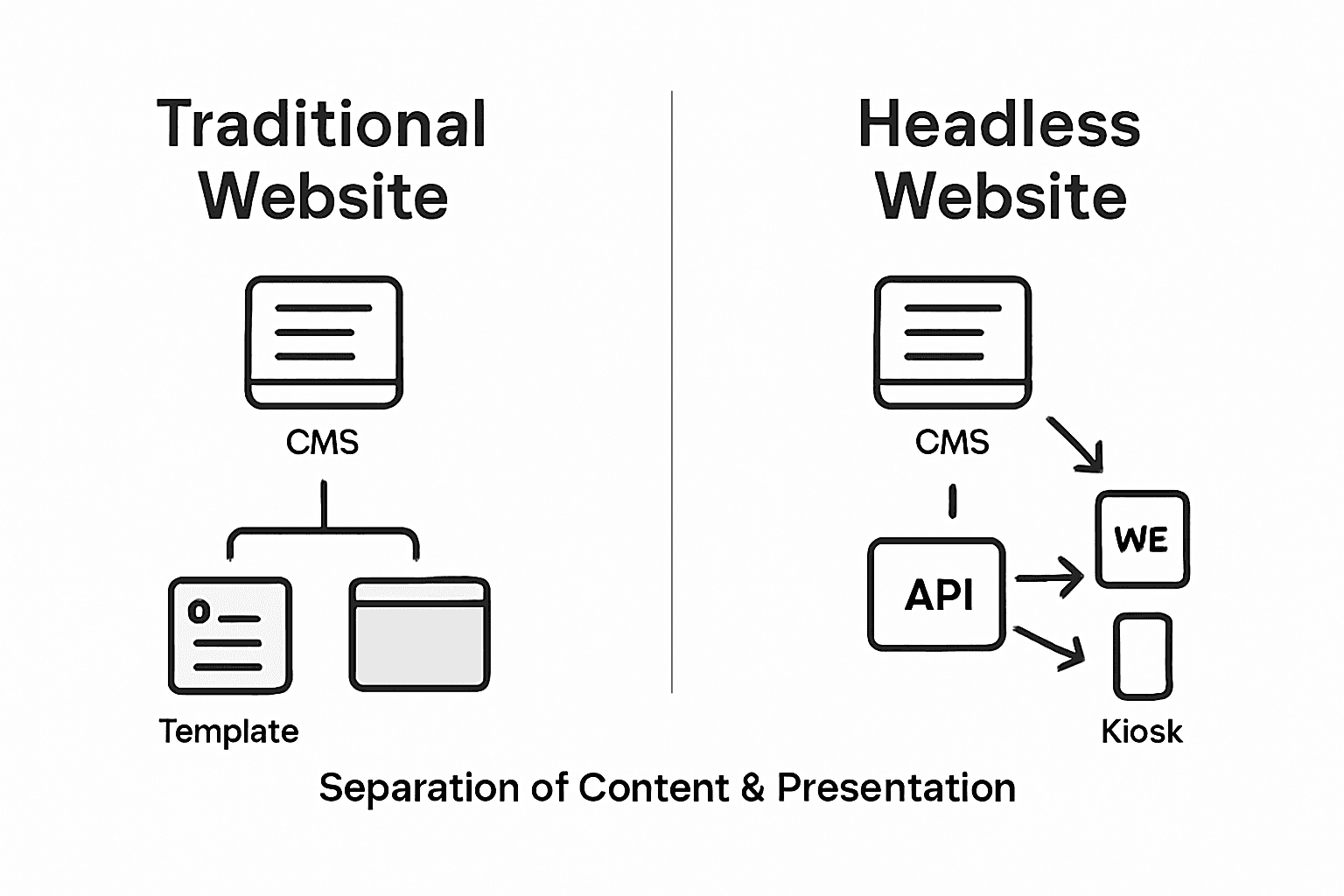
A headless website represents a groundbreaking web architecture where the front-end presentation layer is completely separated from the back-end content management system. In this innovative approach, content is managed independently and delivered via API, enabling unprecedented flexibility for digital platforms.
Traditional websites typically bundle content creation and display within a single system, whereas a headless architecture decouples these components. This means developers can create content repositories that distribute information across multiple channels seamlessly. By removing the rigid front-end presentation constraints, businesses gain the ability to publish content on websites, mobile applications, smart devices, and emerging digital platforms without rebuilding their entire content infrastructure.
The core principle behind headless websites is architectural independence. Software architecture allows front-end and back-end systems to be developed and managed separately, which translates into significant advantages for small and medium enterprises. Teams can select best-of-breed technologies for each layer, update components independently, and create more agile, responsive digital experiences.
Pro Tip for Digital Strategists: When exploring headless website solutions, prioritise platforms that offer robust API capabilities and comprehensive documentation to ensure smooth integration across your digital ecosystem.
How Headless Websites Differ From Traditional Sites
Traditional websites operate on a monolithic architecture where content management and presentation are tightly interconnected. In these systems, changes to the presentation layer directly impact content management, creating a rigid and inflexible digital ecosystem that constrains creativity and adaptability.

By contrast, headless websites revolutionise web development by completely separating content creation from presentation. Modern content management systems now allow frontend rendering through dynamic API consumption, meaning developers can design unique user interfaces without restructuring entire backend systems. This architectural approach enables businesses to create personalised experiences across multiple platforms simultaneously, from websites and mobile applications to smart devices and emerging digital interfaces.
The fundamental differences manifest in several key areas. Traditional sites rely on predefined templates and limited customisation options, whereas headless architectures offer unlimited design possibilities. Content creators can manage information centrally while technical teams independently develop frontend experiences, leading to more efficient workflows and faster digital innovation. This separation allows for greater scalability, enabling small and medium enterprises to adapt quickly to changing technological landscapes without massive infrastructure overhauls.
Here is a concise comparison of traditional and headless website architectures:
| Aspect | Traditional Website | Headless Website |
|---|---|---|
| Architecture | Monolithic, tightly coupled | Modular, front–back separation |
| Customisation Flexibility | Limited, template-based | Unlimited, designer-driven |
| Multi-channel Publishing | Difficult, siloed | Effortless, centralised |
| Development Speed | Slower, changes impact all layers | Faster, concurrent workflows |
| Required Skills | Basic web development | Advanced API and modern frontend |
Pro Tip for Web Developers: When transitioning to headless architectures, invest time in understanding API integration techniques and selecting robust content management platforms that support flexible frontend development.
Key Components and How Headless Works
A headless content management system represents a sophisticated architectural approach centred around three primary components: the content repository, administrative interface, and application programming interface (API). The content management system focuses on creating, organising, and managing digital content through a specialised administrative interface, enabling content creators to work independently from technical implementation constraints.
The API serves as the critical bridge between backend content and frontend presentation layers. Through robust API architecture, content can be dynamically served across multiple platforms, including websites, mobile applications, and internet-connected devices. This approach allows businesses to create a single content source that can be simultaneously published and adapted for various digital touchpoints, eliminating the need for redundant content creation processes.
Key operational mechanics involve content ingestion, storage, taxonomy management, and API-driven distribution. Content creators input and structure information within the backend system, which then becomes available via standardised API calls. Developers can then consume this content and render it using any preferred frontend technology, whether that involves React, Vue, Angular, or custom-built frameworks. This flexibility means technical teams are no longer bound by monolithic system limitations, allowing for more innovative and responsive digital experiences.
Pro Tip for Digital Strategists: When implementing a headless CMS, prioritise platforms with robust API documentation and comprehensive content modelling capabilities to ensure seamless integration and scalability.
Practical Applications for Service Businesses
Service businesses across diverse sectors can leverage headless website architectures to create more dynamic and responsive digital experiences. By integrating headless content management systems with serverless computing, organisations can dramatically optimise web application development, achieving enhanced scalability and reduced operational complexity that traditional monolithic systems cannot match.
Headless CMS platforms enable service businesses to distribute content seamlessly across multiple digital platforms, from websites and mobile applications to internet-connected devices. For instance, a physiotherapy clinic could maintain a consistent patient information repository that automatically updates booking pages, mobile apps, digital signage, and customer communication channels without requiring manual content replication.
Practical implementation scenarios include professional services like dental practices, legal firms, consulting agencies, and fitness studios. These businesses can benefit from centralised content management that allows rapid updates across all digital touchpoints. Technical teams can develop custom frontend experiences using modern web frameworks while content creators maintain full editorial control, ensuring brand consistency and messaging accuracy without technical dependencies.
The table below outlines key business impacts of adopting a headless website approach:
| Benefit | Description | Practical Example |
|---|---|---|
| Scalability | Grows with traffic and digital needs | Expanding from web to mobile apps easily |
| Agility | Rapid deployment of new features | Launching seasonal campaigns swiftly |
| Content Consistency | Single source of truth across platforms | Uniform branding on site and app |
| Resource Efficiency | Reduces duplicate work for teams | Updates published everywhere instantly |
Pro Tip for Service Business Owners: Start with a small, targeted implementation of headless architecture, focusing on one key digital platform to understand the workflow before expanding across your entire digital ecosystem.
Comparing Headless Versus Traditional Approaches
Traditional content management systems represent a monolithic approach where content and presentation are tightly interconnected, creating significant limitations for businesses seeking agile digital strategies. In these conventional setups, website modifications require complex, time-consuming changes across multiple system layers, constraining technical teams and content creators alike.
A headless website architecture fundamentally transforms this paradigm by completely separating content management from presentation logic. This decoupling allows businesses to modify frontend experiences without disrupting underlying content structures, enabling more rapid iteration and innovation. Traditional websites demand simultaneous updates to content and design, whereas headless systems permit independent evolution of each component.
The comparative advantages become particularly pronounced when examining scalability and technological flexibility. Traditional approaches lock businesses into predefined templates and restricted design options, while headless architectures provide unlimited frontend possibilities. Technical teams can leverage modern web frameworks, implement cutting-edge design trends, and create personalised user experiences without being constrained by monolithic backend limitations. This architectural freedom translates into more responsive, adaptable digital platforms that can quickly reflect changing business needs and customer expectations.
Pro Tip for Digital Strategists: Before transitioning to a headless architecture, conduct a comprehensive audit of your current digital infrastructure to identify specific pain points and potential integration challenges.
Costs, Challenges, and Common Missteps
Headless website implementations present complex technical challenges that require sophisticated web development knowledge, particularly for small and medium enterprises with limited technical resources. Unlike traditional website architectures, headless systems demand a higher level of expertise, necessitating skilled developers who understand both frontend and backend technologies, which can significantly impact initial implementation costs.
Successful deployment of headless architectures demands meticulous planning and strategic resource allocation. Common missteps include inadequate API management, insufficient security considerations, and underestimating the complexity of integration. Small businesses must carefully evaluate their technical capabilities, potential skill gaps, and long-term digital strategy before committing to a headless approach.
The financial implications extend beyond initial development. While headless architectures offer long-term flexibility, they require ongoing investment in technical infrastructure, developer training, and continuous system maintenance. Small businesses must weigh the potential benefits of technological agility against the immediate and recurring costs of implementing and sustaining a more complex digital ecosystem. This often involves balancing the desire for cutting-edge digital experiences with practical budgetary constraints.
Pro Tip for Budget-Conscious Strategists: Conduct a comprehensive skills audit of your existing team and consider incremental headless implementation, starting with a single, low-risk digital platform to manage initial complexity and control costs.
Unleash the Power of Headless Websites with Expert Automation
Struggling with the complexity and technical demands of transitioning to a headless website architecture? You are not alone. Many small and medium enterprises face challenges like managing API integrations, maintaining content consistency across platforms, and ensuring scalable, agile digital workflows. The article highlights the benefits of decoupling content management from presentation but also recognises the technical expertise required to implement such systems successfully.
At Fame Razak, we specialise in helping small businesses and agencies automate the tasks that slow productivity, including integrating flexible website solutions that align perfectly with headless architecture principles. By leveraging advanced automation and AI-driven workflow orchestration, we help you streamline content delivery, reduce manual efforts, and empower your team to focus on growth. Discover how our tailored fractional CTO services can transform your digital operations by visiting our homepage and learn practical approaches to simplify your technology stack.
Don’t let technical hurdles stall your progress. Explore how to make headless architecture work for your business today through our expert guidance. Start now at Fame Razak and unlock the agility and scalability your service business deserves.
Frequently Asked Questions
What is a headless website?
A headless website is a web architecture where the front-end presentation layer is completely separated from the back-end content management system, allowing for greater flexibility in delivering content across multiple platforms.
How do headless websites differ from traditional websites?
Headless websites separate content management from presentation, enabling unlimited design possibilities and multi-channel publishing, while traditional websites use a monolithic approach that tightly integrates these components, limiting flexibility and innovation.
What are the key components of a headless content management system?
The key components of a headless CMS include the content repository, the administrative interface for managing content, and the application programming interface (API) that facilitates the delivery of content to various front-end platforms.
What are the benefits of using a headless website for service businesses?
Service businesses can achieve scalability, agility, content consistency, and resource efficiency by utilising headless website architectures, enabling them to distribute content seamlessly across multiple digital platforms without the need for redundant content creation.
Recommended
- 7 Best Practices in Website Development for Small Businesses – Fame Razak
- Headless WordPress Site Explained: Complete Guide – Fame Razak
- 7 Key Types of Web Architectures for Modern Businesses – Fame Razak
- Headless WordPress Explained: Benefits and Use Cases – Fame Razak
- Headless Commerce Explained: Complete Guide for Shopify