
Most advice about choosing a technology stack overlooks how crucial it is to define clear requirements before diving in. For many British companies, skipping this foundation leads to costly missteps down the line. In fact, studies show that over 50 percent of failed technology projects trace back to unclear or incomplete requirements. This guide breaks down every key stage, helping you make smart decisions that fit your business goals and user needs from the very start.
Table of Contents
- Stage 1: Define Business And User Requirements
- Stage 2: Identify Essential Technical Criteria
- Stage 3: Research Available Technology Options
- Stage 4: Evaluate And Compare Shortlisted Stacks
- Stage 5: Validate Choices Through Prototyping
- Stage 6: Implement And Review The Selected Stack
Quick Summary
| Important Insight | Explanation |
|---|---|
| 1. Define precise requirements | Clearly outline business and user needs for technology to ensure effective tech stack selection. |
| 2. Create an evaluation framework | Develop a structured method to assess each technology stack against predefined criteria and business objectives. |
| 3. Conduct thorough research | Use diverse sources to identify technologies that meet your needs, ensuring comprehensive insights and analysis. |
| 4. Involve stakeholders in evaluation | Engage team members from various departments to gain diverse perspectives on technology stacks and potential challenges. |
| 5. Embrace prototyping for validation | Use prototypes to test technology stacks in real-world scenarios, gathering practical insights before full implementation. |
Stage 1: Define business and user requirements
Defining precise business and user requirements is the foundational step in selecting an effective tech stack. In this critical phase, you will map out exactly what your technology needs to accomplish and who will be using it.
Begin by conducting a comprehensive analysis of your organisation’s strategic objectives. This involves gathering insights from key stakeholders across different departments to understand their specific technological needs and pain points. Systematic requirement elicitation techniques can help you uncover nuanced requirements that might otherwise be overlooked. Break down your requirements into clear categories such as functionality, performance, scalability, security, and user experience.
Next, develop detailed user personas that represent the different types of individuals who will interact with your technology. Consider their technical skills, workflow patterns, and specific expectations. The Systems Development Life Cycle analysis phase emphasises decomposing systems into manageable pieces and engaging users directly in defining requirements. This means conducting user interviews, creating journey maps, and validating assumptions through direct feedback.
A word of caution: avoid the common pitfall of collecting requirements too broadly. Be specific, prioritise ruthlessly, and focus on requirements that directly support your core business objectives. By taking a structured yet flexible approach, you set the stage for a tech stack selection process that truly meets your organisation’s needs.
Stage 2: Identify essential technical criteria
Identifying essential technical criteria involves creating a comprehensive framework that evaluates potential technologies against your specific organisational requirements. This crucial step helps you filter and prioritise technologies that can genuinely support your business objectives.
Start by mapping out key performance metrics that matter most to your organisation. Scalability and performance considerations should be at the forefront of your evaluation process. Assess each potential technology stack against critical dimensions such as processing speed, memory usage, concurrent user handling, and future growth potential. Consider both your current operational needs and anticipated expansion requirements.

Implement a rigorous evaluation process that includes comprehensive testing strategies. Comprehensive testing approaches are essential for validating the reliability and robustness of your potential tech stack. This means conducting multiple testing levels including unit testing, integration testing, performance testing, and security assessments. Pay special attention to how each technology stack supports these critical evaluation dimensions.
A strategic tip: create a weighted scoring matrix that assigns importance to different technical criteria. This approach transforms subjective assessments into objective measurements, allowing you to compare technologies systematically. By methodically evaluating each potential stack against your predefined criteria, you will make a more informed and strategic technology selection.
Stage 3: Research available technology options
Researching available technology options is a strategic exploration that will help you discover the most suitable technologies for your organisation’s unique requirements. This stage involves a systematic approach to uncovering potential solutions that align with your technical and business objectives.
Begin your research by leveraging multiple information sources. Advanced technology retrieval techniques suggest using meta-search approaches to comprehensively collect potential technologies. Explore professional networks, developer forums, industry conferences, technology blogs, and academic publications. Pay close attention to technologies that have demonstrated consistent performance and adoption in your specific domain.
Next, analyse the historical usage and longevity of potential technologies. Comprehensive technology usage analysis provides valuable insights into which technologies have sustained relevance over extended periods. Look beyond current trends and examine technologies that have proven resilient and adaptable. Consider factors such as community support, documentation quality, update frequency, and the ecosystem surrounding each technology stack.
A critical tip: create a structured tracking system for your research. Document each technology’s strengths, weaknesses, community support, and alignment with your specific requirements. This methodical approach transforms random research into a strategic intelligence gathering process, ensuring you make an informed technology selection based on comprehensive evidence rather than fleeting impressions.
Stage 4: Evaluate and compare shortlisted stacks
Evaluating and comparing shortlisted technology stacks is a critical decision making process that will determine the future technological foundation of your organisation. This stage requires a methodical and comprehensive approach to assess each potential stack against your predefined requirements and strategic objectives.
Systematic technology comparison techniques recommend creating a detailed evaluation matrix that scores each technology stack across multiple dimensions. Break down your assessment into key performance indicators such as scalability, security, ease of implementation, learning curve, community support, integration capabilities, and long term maintainability. Assign weighted scores to each criterion based on their importance to your specific organisational context, ensuring a rigorous and objective comparison.
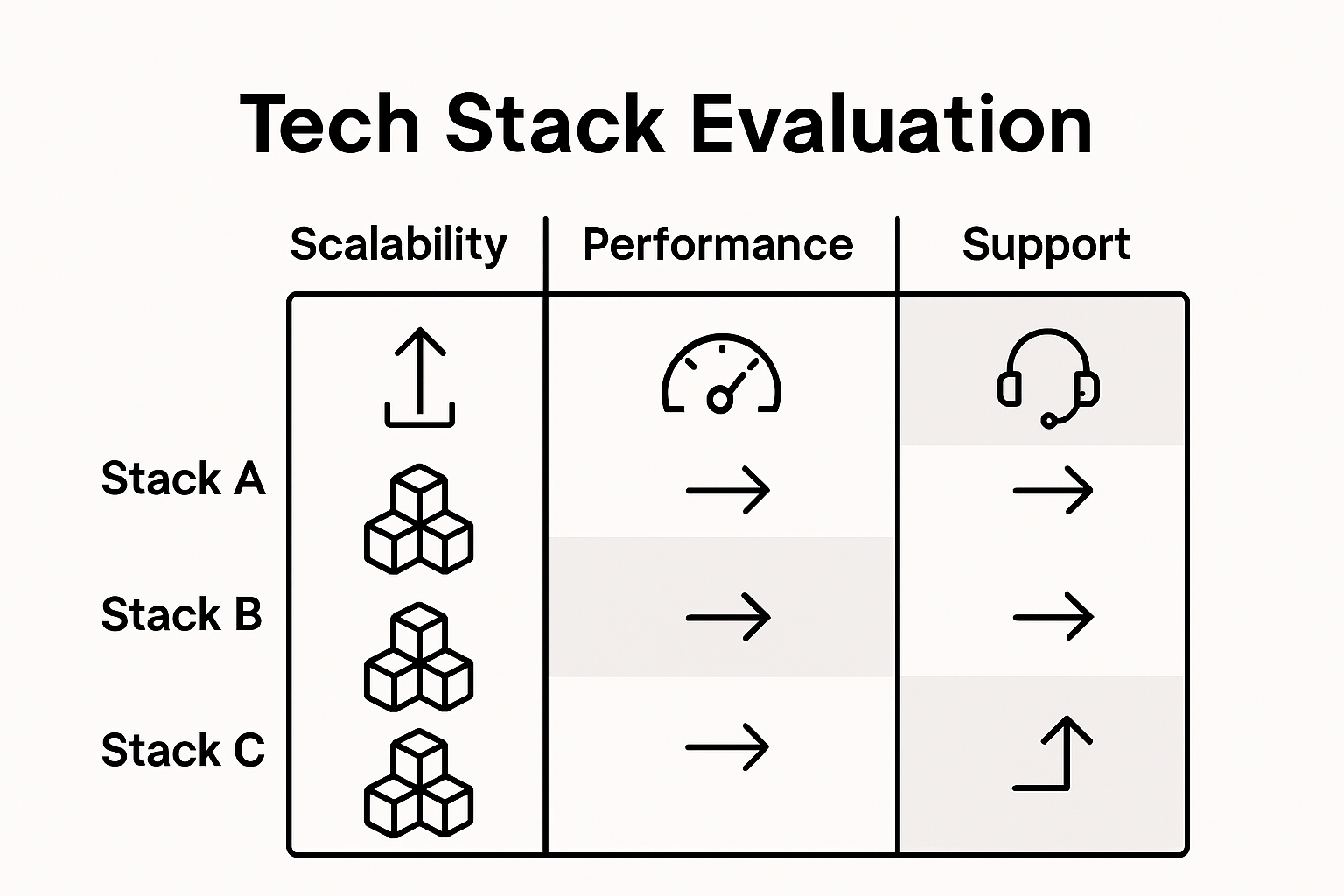
During your evaluation, conduct practical experiments and proof of concept tests with each shortlisted technology stack. Simulate real world scenarios that mirror your actual business requirements, allowing you to understand how each technology performs under conditions closely resembling your operational environment. Pay particular attention to aspects like processing speed, resource utilisation, development complexity, and potential future adaptability.
A critical tip: involve key stakeholders from different departments in the evaluation process. Their diverse perspectives will help uncover potential challenges and opportunities that might not be immediately apparent. By creating a collaborative assessment approach, you transform technology selection from a purely technical decision into a strategic organisational initiative.
Stage 5: Validate choices through prototyping
Prototyping serves as the critical validation stage where theoretical technology assessments transform into practical insights. This hands-on approach allows you to test your shortlisted technology stacks in a controlled yet realistic environment, revealing potential challenges and opportunities before full implementation.
Building a strategic prototype requires careful planning and a structured approach. Select a small but representative project that encompasses key functional requirements and technical challenges relevant to your organisation. Develop a minimum viable prototype that tests critical aspects such as system integration, performance under load, data processing capabilities, and user interaction workflows. This focused experiment will provide tangible evidence of each technology stack’s real world suitability.
Utilise technology roadmapping principles to create a comprehensive validation framework. Document your prototype development process meticulously, tracking performance metrics, development complexity, learning curve, and potential scaling challenges. Engage stakeholders from different departments to gather diverse perspectives on the prototype’s functionality and potential limitations. Pay close attention to how each technology stack handles unexpected scenarios and adapts to emerging requirements.
A critical warning: prototyping is not about perfection but about learning. Embrace the imperfections and unexpected challenges as valuable insights that will inform your final technology selection. By approaching prototyping with curiosity and strategic intent, you transform a technical evaluation into a powerful organisational learning opportunity.
Stage 6: Implement and review the selected stack
Implementing and reviewing your selected technology stack marks the critical transition from strategic planning to practical execution. This phase transforms your carefully researched and validated technological choices into a functioning organisational infrastructure that will support your business objectives.
Systematic implementation approaches require a structured methodology that encompasses coding, testing, debugging, and gradual deployment. Begin by creating a phased implementation plan that allows incremental rollout of your new technology stack. Start with non critical systems or pilot projects that minimise potential operational disruptions. Develop comprehensive test scenarios that validate each component’s performance, integration capabilities, and alignment with your predefined requirements.
Methodical software development principles emphasise the importance of continuous review and refinement. Establish a robust monitoring framework that tracks key performance indicators, system reliability, and user experience metrics. Engage cross functional teams to provide diverse perspectives on the implementation, creating feedback loops that allow for rapid adjustments and optimisations. Document every implementation stage meticulously, capturing lessons learned and potential improvement opportunities.
A critical insight: implementation is not a one time event but an ongoing process of adaptation and improvement. Remain flexible and prepared to make iterative adjustments as your organisation learns and evolves with the new technology stack. Embrace a culture of continuous learning and technological agility that allows your systems to grow alongside your business needs.
Transform Your Tech Stack Selection Into a Seamless Success
Choosing the right technology stack is a complex challenge that demands clarity, precision and hands-on validation. This article highlights the need to define business objectives carefully and rigorously evaluate technical criteria before fully committing. If you feel overwhelmed by the pressure to balance scalability, integration, and user experience while avoiding costly mistakes, you are not alone. Many small businesses and agencies struggle to turn this strategic process into practical, efficient action without losing sight of their core operations.
At Fame Razak, we understand these critical pain points as a Fractional CTO deeply rooted in agency workflows. Our solutions automate and orchestrate essential tasks like client onboarding, scheduling, and AI receptionist support to remove operational bottlenecks. Combining intelligent automation with proven technology selection strategies means you can accelerate your technology stack decisions with confidence. Ready to move from uncertainty to clarity? Discover how to simplify your tech stack evaluation and implementation journey today by visiting our main site and exploring tailored approaches that let you focus on what matters most.
Frequently Asked Questions
What are the first steps in defining business and user requirements for tech stack selection?
Begin by analysing your organisation’s strategic objectives and gathering insights from key stakeholders across various departments. Conduct interviews and create user personas to develop a clear understanding of their specific technological needs.
How do I identify essential technical criteria for evaluating tech stacks?
Identify key performance metrics such as scalability, processing speed, and resource utilisation relevant to your organisation. Create an evaluation framework that scores potential technologies against these metrics, ensuring each aligns with your business objectives.
What methods can I use to research available technology options?
Leverage multiple information sources, including professional networks, industry blogs, and developer forums, to uncover suitable technologies. Document the strengths and weaknesses of each option in a structured manner to assist in the decision-making process.
How should I evaluate and compare shortlisted technology stacks?
Create a detailed evaluation matrix that scores each shortlisted technology across key performance indicators like security, ease of implementation, and community support. Conduct experiments simulating real-world scenarios to assess how each technology performs under conditions similar to your operational environment.
What is the purpose of prototyping in tech stack selection?
Prototyping serves to validate your chosen technology stacks in a practical setting, allowing you to identify potential challenges before full implementation. Develop a minimum viable prototype that tests critical aspects such as system integration and user interaction.
How do I implement and review the selected technology stack effectively?
Follow a phased implementation plan, starting with non-critical systems to minimise disruptions. Establish a monitoring framework to track performance and gather feedback from cross-functional teams for continuous improvement.