
Over 60 percent of British online shoppers have used a multi vendor ecommerce platform, yet many sellers misunderstand how these digital marketplaces really work. The growth of British ecommerce means both new and established businesses are looking for ways to stand out in crowded markets. This guide clears up common myths about multi vendor platforms and sheds light on the real opportunities and challenges for British entrepreneurs aiming to compete online.
Table of Contents
- Multi Vendor Ecommerce Defined And Debunked
- Types Of Multi Vendor Ecommerce Platforms
- How Multi Vendor Marketplaces Operate
- Essential Features For Vendors And Owners
- Benefits And Drawbacks For Small Businesses
- Key Risks, Costs And Mistakes To Avoid
Key Takeaways
| Point | Details |
|---|---|
| Multi Vendor Ecommerce Advantages | Multi vendor platforms provide small businesses with significant market access, reduced costs, and advanced operational tools, fostering competition against larger retailers. |
| Platform Selection Strategy | Conduct thorough evaluations of platform features and commission structures to ensure alignment with specific business needs and operational goals. |
| Operational Risks Management | Vendors should implement robust operational frameworks to address potential pitfalls in inventory management, product quality, and financial planning. |
| Technology and Security Focus | Prioritise secure technological infrastructures and data privacy measures to mitigate risks inherent in digital marketplaces. |
Multi Vendor Ecommerce Defined And Debunked
A multi vendor ecommerce platform represents a sophisticated digital marketplace where multiple independent sellers can simultaneously list, market, and sell their products through a single centralised online environment. The comprehensive system enables diverse vendors to create personalised digital storefronts within a unified technological infrastructure, transforming traditional retail paradigms.
Unlike conventional single-vendor platforms, multi vendor systems provide remarkable flexibility and scalability. Vendors gain substantial autonomy in managing their product catalogues, pricing strategies, and individual brand identities while benefiting from the platform’s shared technological ecosystem. These platforms typically feature robust backend systems that handle critical operational functions such as inventory management, order processing, payment integrations, and seller performance tracking.
The emergence of multi vendor marketplaces represents a profound shift in digital commerce dynamics. Platform-based marketplaces are fundamentally reshaping retail by seamlessly integrating online and offline consumer experiences, creating interconnected ecosystems that transcend traditional transactional boundaries. Key characteristics include:
- Decentralised seller management
- Comprehensive product diversity
- Integrated payment and shipping solutions
- Real-time inventory synchronisation
- Transparent seller performance metrics
Vendors benefit from reduced infrastructure investments, while consumers enjoy unprecedented product variety and competitive pricing. The platform essentially becomes a digital intermediary, facilitating complex commercial interactions with minimal friction.
Pro Seller Strategy: Research multiple multi vendor platforms meticulously before committing, evaluating their technical capabilities, commission structures, and seller support ecosystems to ensure alignment with your specific business requirements.
Types Of Multi Vendor Ecommerce Platforms
Multi vendor ecommerce platforms represent diverse technological ecosystems designed to support complex digital marketplaces. Cloud-based solutions have emerged as particularly sophisticated models for managing multi-tenant and multi-vendor interactions, offering unprecedented scalability and operational flexibility.
These platforms can be categorically segmented into several distinctive archetypes, each addressing unique business requirements and technological constraints. The primary types include:
-
Horizontal Marketplace Platforms
- Support vendors across multiple product categories
- Examples: Amazon, eBay
- Broad consumer reach
-
Vertical Niche Platforms
- Specialise in specific product domains
- Targeted marketplace ecosystems
- Enhanced expertise in particular sectors
-
Branded Multi Vendor Platforms
- Owned and operated by a single brand
- Curated vendor selection
- Consistent brand experience
-
Open Source Multi Vendor Solutions
- Customisable technological frameworks
- Lower initial infrastructure costs
- Greater technical control
Comparative analyses of multi-vendor platforms reveal significant variations in operational models and technological frameworks, highlighting the importance of strategic platform selection. Each type presents unique advantages, requiring businesses to carefully evaluate their specific operational needs, target market dynamics, and technological capabilities.

For clarity, the table below compares key types of multi vendor ecommerce platforms and their typical strategic use cases:
| Platform Type | Strategic Focus | Ideal Business Model |
|---|---|---|
| Horizontal Marketplace | Broad product variety | General consumer retail |
| Vertical Niche Platform | Targeted sector expertise | Specialist and boutique businesses |
| Branded Multi Vendor | Consistent brand experience | Brands seeking curated selections |
| Open Source Solution | Customisable technology stack | Tech-driven or unique requirements |
The selection process demands comprehensive understanding of platform architectures, integration capabilities, scalability potential, and vendor management tools. Successful implementation hinges on aligning platform characteristics with specific business objectives and growth strategies.
Pro Platform Selection Strategy: Conduct a rigorous technical and operational audit of potential multi vendor platforms, mapping their features against your specific business requirements to ensure optimal technological compatibility and future scalability.
How Multi Vendor Marketplaces Operate
Multi vendor marketplaces function as intricate digital ecosystems where complex interactions between buyers, sellers, and platform operators create dynamic commercial environments. Price competition among vendors represents a sophisticated two-stage strategic interaction, where sellers simultaneously navigate pricing strategies and market positioning.
The operational framework of these marketplaces typically involves several critical technological and transactional mechanisms:
-
Vendor Onboarding
- Comprehensive registration processes
- Background and product quality verification
- Performance evaluation systems
-
Product Listing Management
- Individual vendor catalogue uploads
- Real-time inventory tracking
- Automated pricing and availability updates
-
Transaction Processing
- Secure payment gateway integrations
- Commission calculation
- Revenue sharing mechanisms
-
Performance Monitoring
- Customer review systems
- Seller rating algorithms
- Continuous quality control
Blockchain technologies are increasingly transforming these marketplaces by introducing enhanced transparency and direct customer-seller connections, providing unprecedented levels of trust and data sovereignty. These technological innovations enable more secure, decentralised transaction frameworks that mitigate traditional intermediary risks.
Successful multi vendor marketplaces balance technological sophistication with user experience, creating seamless environments where vendors can efficiently showcase products and customers can access diverse offerings with minimal friction. The platform’s role extends beyond mere transactional facilitation to curating meaningful commercial interactions.
Pro Operational Strategy: Design robust vendor onboarding processes that balance rigorous quality control with accessible entry requirements, ensuring your marketplace maintains high standards while remaining attractive to diverse sellers.
Essential Features For Vendors And Owners
Multi vendor e-commerce platforms demand comprehensive technological infrastructures that enable seamless interactions between platform owners, vendors, and customers. Essential platform features encompass sophisticated authentication mechanisms, role-based access controls, and intricate operational management systems, creating robust digital ecosystems for commercial transactions.
The critical features can be categorised into distinct operational domains:
For Platform Owners:
- Advanced analytics dashboards
- Comprehensive vendor performance tracking
- Revenue management systems
- Automated commission calculation
- Fraud detection mechanisms
For Vendors:
- Intuitive product management interfaces
- Real-time inventory synchronisation
- Customisable storefront designs
- Detailed sales reporting
- Integration with multiple payment gateways
Cloud-based architectures provide exceptional scalability and cost-effectiveness for multi-vendor platforms, enabling platforms to support diverse vendor requirements while maintaining operational efficiency. These technological frameworks allow dynamic resource allocation and seamless tenant management.
Successful multi vendor platforms require a delicate balance between vendor autonomy and platform governance. The technological infrastructure must simultaneously protect platform integrity, facilitate vendor success, and ensure exceptional customer experiences. This involves creating flexible yet secure environments that adapt to evolving market dynamics.
Pro Platform Design Strategy: Implement modular feature sets that allow granular permission controls, enabling vendors to access precisely the tools they need while maintaining robust security protocols.
Benefits And Drawbacks For Small Businesses
Multi vendor e-commerce platforms represent a transformative opportunity for small businesses, offering unprecedented market access and operational flexibility. These digital ecosystems enable small enterprises to compete alongside larger retailers by providing sophisticated technological infrastructures that were previously unavailable or prohibitively expensive.
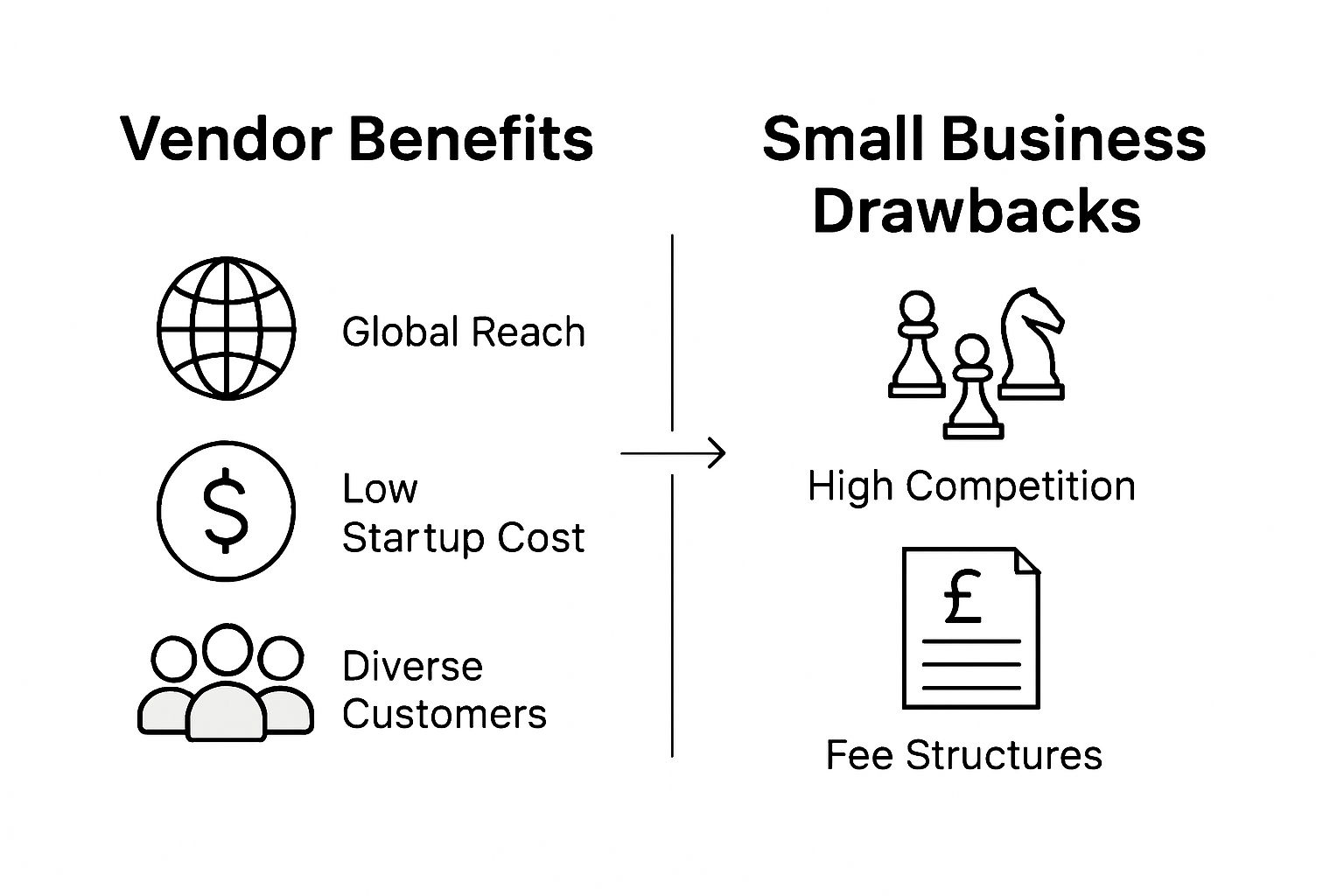
The strategic advantages for small businesses include:
Significant Benefits:
- Immediate market expansion
- Reduced infrastructure investments
- Lower customer acquisition costs
- Access to advanced technological tools
- Simplified inventory management
- Global sales potential
Potential Drawbacks:
- Intense marketplace competition
- Platform dependency risks
- Reduced profit margins
- Complex fee structures
- Limited brand differentiation
- Performance evaluation pressures
Multi vendor platforms can empower small and medium-sized businesses by creating opportunities to reach broader audiences while managing operational complexities, though success requires strategic navigation of platform dynamics.
Navigating these digital marketplaces demands nuanced understanding. Small businesses must carefully evaluate platform features, commission structures, and alignment with their specific operational goals. The most successful vendors approach multi vendor platforms as strategic partnerships, investing time in understanding platform mechanics and continuously optimising their approach.
Pro Marketplace Strategy: Conduct comprehensive platform comparisons, prioritising those offering transparent fee structures, robust vendor support, and alignment with your specific product category and business model.
Key Risks, Costs And Mistakes To Avoid
Multi vendor e-commerce platforms present complex challenges that can significantly impact business performance and sustainability. Price competition dynamics create intricate strategic environments where inefficient equilibria can emerge, potentially undermining vendor profitability, demanding sophisticated market navigation strategies.
The primary risks and potential costly mistakes include:
Financial Risks:
- Underestimating platform commission rates
- Inappropriate pricing strategies
- Inadequate cost management
- Unexpected operational expenses
- Insufficient profit margin calculations
Operational Risks:
- Poor inventory management
- Inconsistent product quality
- Delayed order processing
- Ineffective customer communication
- Limited performance tracking
Technological Vulnerabilities:
- Compromised data privacy and security mechanisms
- Insufficient transaction transparency
- Complex integration challenges
- Limited technological scalability
- Potential cybersecurity exposure
Successful multi vendor marketplace participation requires comprehensive risk mitigation strategies. Vendors must develop robust operational frameworks that anticipate potential challenges, continuously adapt to platform dynamics, and maintain stringent quality control measures. Proactive risk management involves regular performance audits, technological infrastructure assessments, and dynamic pricing strategies.
The following table highlights common financial, operational, and technological pitfalls, with practical mitigation approaches for vendors:
| Risk Area | Typical Pitfall | Practical Mitigation Approach |
|---|---|---|
| Financial | Underestimating commission structure | Use regular financial modelling |
| Operational | Poor quality control | Implement robust order quality checks |
| Technological | Limited data security | Adopt proven encryption and privacy tools |
Pro Risk Management Strategy: Implement a comprehensive vendor risk assessment protocol that includes regular platform performance reviews, detailed financial modelling, and adaptive technological infrastructure planning.
Unlock Your Multi Vendor Ecommerce Potential with Smarter Automation
Navigating the complex world of multi vendor ecommerce demands seamless coordination between vendors, inventory, pricing, and customer experience. The article highlights key challenges such as managing decentralised seller operations, optimising pricing strategies, and ensuring transparent performance tracking. If you are a small business or agency looking to overcome these operational bottlenecks and reduce the risk of costly mistakes, embracing intelligent automation is essential.
At Fame Razak, we specialise in automating the very processes that can slow down your marketplace growth, from vendor onboarding workflows to real-time inventory synchronisation and payment processing. Our expertise as a Fractional CTO with deep agency roots means we can help you transform everyday ecommerce operations into scalable, intelligent systems that empower your team and boost seller performance. Discover practical ways to integrate AI-driven workflow orchestration and automation by exploring our innovative solutions at https://famerazak.com.
Ready to simplify your multi vendor ecommerce management and focus on what really matters — growing your business and delighting customers? Start by learning how to automate critical marketplace functions and unlock new efficiencies with Fame Razak. Take control of your digital marketplace today to gain a competitive edge and secure sustainable success.
Frequently Asked Questions
What is a multi vendor ecommerce platform?
A multi vendor ecommerce platform is a digital marketplace where multiple independent sellers can list and sell their products through a single online environment, allowing for diverse product offerings and vendor autonomy.
What are the main types of multi vendor ecommerce platforms?
The primary types include horizontal marketplace platforms, which support multiple product categories; vertical niche platforms, which specialise in specific sectors; branded multi vendor platforms, owned by a single brand; and open source solutions, allowing for customisation and control.
How does a multi vendor marketplace operate?
Multi vendor marketplaces operate through a framework of vendor onboarding, product listing management, transaction processing, and performance monitoring, facilitating interactions between buyers and sellers while ensuring a smooth commercial experience.
What are some benefits and drawbacks for small businesses using multi vendor platforms?
Benefits for small businesses include immediate market expansion, reduced infrastructure costs, and access to advanced tools. However, drawbacks may involve intense competition, platform dependency risks, and potential for lower profit margins.