
Most advice about digital transformation misses what truly matters to british organisations—the people at the heart of change. While technology gets plenty of attention, ignoring staff perspectives and workplace culture can undermine even the most advanced solutions. Nearly 70 percent of digital initiatives fail due to a lack of employee engagement. This article highlights how a human centred approach empowers british businesses to create lasting, people-driven technology success.
Table of Contents
- What Human Centred Digital Transformation Means
- Core Principles Behind A People-First Approach
- Key Technologies And Business Automation Methods
- Real-World Applications For Small Service Businesses
- Common Mistakes And Overlooked Risks To Manage
Key Takeaways
| Point | Details |
|---|---|
| Human Centred Approach | Prioritising people and organisational culture in digital transformation fosters meaningful and sustainable technological solutions. |
| Collaboration and Inclusion | Successful strategies rely on employee involvement, reducing resistance and enhancing adaptation to change. |
| Continuous Learning and Skill Development | Ongoing training in new technologies is essential for empowering employees and ensuring they complement human capabilities. |
| Risks and Change Management | A comprehensive strategic roadmap is vital to mitigate common pitfalls linked to technology implementation and cultural shifts. |
What Human Centred Digital Transformation Means
Human centred digital transformation represents a holistic approach to technological change that prioritises people over pure technological capability. Unlike traditional digital strategies that focus solely on technical implementation, this methodology places human experiences, skills, and organisational culture at the core of digital evolution. By understanding digital transformation through a human lens, businesses can create more meaningful, sustainable technological solutions that genuinely enhance workplace productivity and employee engagement.
At its essence, human centred digital transformation goes beyond merely adopting new technologies. It involves understanding how technological capabilities can support human potential, rather than replacing human workers. This approach recognises that successful digital strategies must balance technological efficiency with ethical considerations and cultural dynamics. Modern small and medium enterprises (SMEs) are increasingly recognising that digital transformation is not about replacing human capabilities, but augmenting and empowering them through intelligent technological solutions.
The fundamental principles of human centred digital transformation include deep employee consultation, ongoing skills development, transparent change management, and creating technological ecosystems that feel intuitive and supportive. These principles ensure that digital initiatives are not imposed from the top down, but co-created with the people who will ultimately use and benefit from them. By involving staff in the transformation journey, organisations can reduce resistance, increase adoption rates, and create more resilient, adaptable technological infrastructures.
Pro Tip for Implementation: Start small by mapping your current workflows and identifying specific human pain points where digital solutions can provide meaningful support, rather than attempting a complete organisational overhaul in one go.
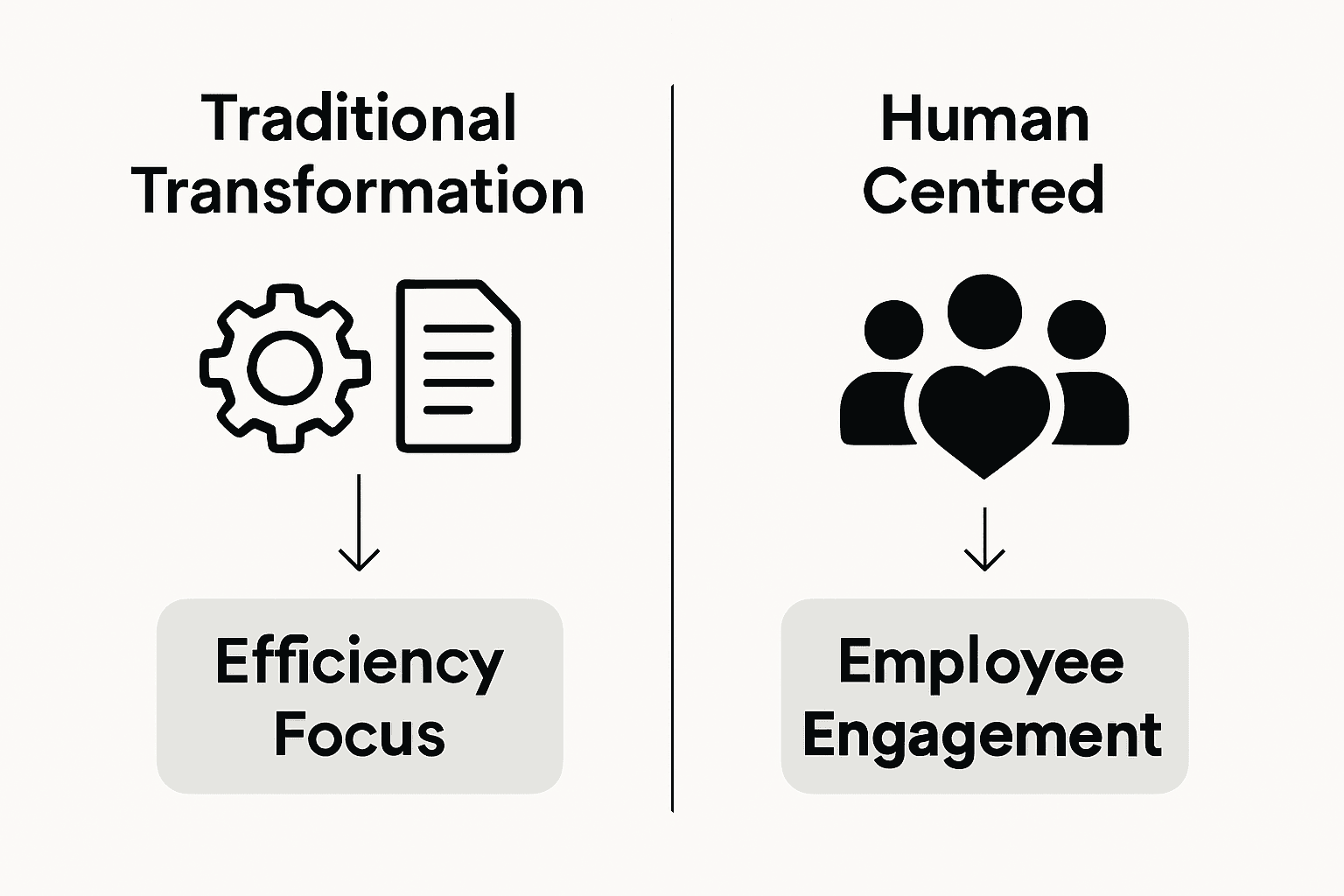
To clarify the different approaches to digital transformation, consider the following comparison:
| Aspect | Traditional Digital Transformation | Human Centred Digital Transformation |
|---|---|---|
| Primary Focus | Technology implementation | People and culture |
| Change Management | Top-down directives | Collaborative involvement |
| Success Measurement | System efficiency | Employee engagement |
| Approach to Skills | Training after rollout | Ongoing skills development |
| Typical Pitfall | Resistance and low adoption | Increased buy-in and flexibility |
Core Principles Behind a People-First Approach
A people-first approach to digital transformation fundamentally reimagines technological change as a collaborative journey rather than a technical implementation. Understanding the interconnected nature of leadership, employee engagement, and cultural transformation becomes critical in developing sustainable digital strategies that genuinely empower organisations and their workforce.
The core principles of this approach centre on five key dimensions: empathy, inclusivity, continuous learning, transparent communication, and adaptive design. Empathy emerges as the foundational principle, requiring business leaders to deeply understand employee experiences and challenges before introducing technological solutions. This means moving beyond traditional top-down change management and creating participatory environments where staff feel genuinely heard and valued throughout the digital transformation process.
Practical implementation of these principles involves structured methodologies like design thinking, which emphasises problem framing, ideation, and iterative testing of solutions. Small and medium enterprises can adopt this approach by creating cross-functional teams, conducting employee workshops, and developing pilot programmes that allow gradual technological integration. The goal is not wholesale replacement of existing systems, but thoughtful augmentation that respects current workflows and individual capabilities.
Pro Tip for Culture Alignment: Create a digital transformation steering committee that includes representatives from different organisational levels to ensure diverse perspectives are genuinely considered during technological change initiatives.
Key Technologies and Business Automation Methods
In the realm of human centred digital transformation, technology serves as an enabler rather than a replacement for human capabilities. Developing a comprehensive digital transformation roadmap requires strategic alignment between technological innovation and organisational goals, focusing on key technologies that enhance rather than diminish human potential.

Intelligent automation technologies represent the cornerstone of modern business transformation. These include robotic process automation (RPA), artificial intelligence (AI), machine learning algorithms, and advanced workflow orchestration platforms. Small and medium enterprises can leverage these technologies to streamline repetitive tasks, allowing human workers to concentrate on higher-value strategic activities that require creativity, emotional intelligence, and complex problem-solving skills. Critical automation methods include intelligent document processing, automated customer interaction systems, predictive analytics dashboards, and integrated communication platforms that reduce administrative overhead.
The integration of these technologies demands a nuanced approach that prioritises skill development and ethical implementation. Developing foundational knowledge in AI literacy, problem-solving capabilities, and understanding ethical technology practice becomes essential for successful digital transformation. Businesses must invest in continuous learning programmes that help employees understand and effectively collaborate with emerging technologies, ensuring that automation serves as an empowerment tool rather than a source of workplace anxiety.
Pro Tip for Technology Integration: Conduct a comprehensive workflow audit before implementing any automation technology, identifying repetitive tasks that can be automated while preserving human judgment and creativity in critical decision-making processes.
Real-World Applications for Small Service Businesses
Small service businesses represent a unique ecosystem where digital transformation can yield substantial operational improvements. Developing a strategic approach that integrates customer experience, data analytics, and modern technology platforms becomes critical for sustainable growth and competitive advantage.
Digital transformation strategies for service businesses typically focus on three key areas: client engagement, operational efficiency, and workforce empowerment. Practical applications include intelligent scheduling systems for healthcare practitioners, automated booking platforms for beauty salons, customer relationship management (CRM) tools for personal trainers, and integrated communication systems for consultancy practices. These technologies enable small businesses to streamline administrative tasks, reduce manual data entry, personalise client interactions, and create more meaningful engagement without sacrificing the human touch.
Here is a summary of how key automation technologies impact small service businesses:
| Technology | Typical Application | Human Impact |
|---|---|---|
| Robotic Process Automation | Automate repetitive admin tasks | Frees time for client care |
| AI & Machine Learning | Personalised service suggestions | Augments decision-making |
| CRM Systems | Manage client relationships | Enhances communication |
| Predictive Analytics | Anticipate customer needs | Supports proactive action |
Understanding the interconnected nature of leadership, employee engagement, and technological adaptation proves essential for successful implementation. Small service businesses must view digital transformation not as a technical upgrade, but as a holistic approach to enhancing organisational capabilities. This means investing in staff training, creating adaptive technological ecosystems, and developing a culture that views digital tools as collaborative partners rather than replacements for human expertise.
Pro Tip for Service Business Transformation: Start with one high-impact digital solution that directly addresses your most significant operational bottleneck, and gradually expand your technological capabilities based on tangible results and team feedback.
Common Mistakes and Overlooked Risks to Manage
Digital transformation presents numerous potential pitfalls that can derail even the most well-intentioned technological initiatives. Developing a comprehensive strategic roadmap that anticipates potential challenges becomes crucial for sustainable digital evolution, helping small businesses navigate complex technological transitions.
Critical risk areas emerge across multiple dimensions of organisational change. Technology implementation often fails due to inadequate change management, poor staff training, and a fundamental misunderstanding of how digital tools should complement human capabilities. Common mistakes include over-investing in complex technologies without clear strategic objectives, neglecting employee skill development, implementing solutions that create more friction than efficiency, and failing to establish robust data privacy and security protocols. Small service businesses frequently underestimate the cultural shift required, treating digital transformation as a technical upgrade rather than a holistic organisational metamorphosis.
Understanding the interconnected nature of leadership, employee engagement, and technological adaptation is paramount in mitigating transformation risks. Successful digital strategies require transparent communication, phased implementation, continuous learning programmes, and a genuine commitment to helping employees understand and embrace technological changes. Businesses must create psychological safety, where staff feel supported in learning new skills and do not perceive technological innovation as a threat to their professional relevance.
Pro Tip for Risk Mitigation: Create a dedicated digital transformation steering committee with representatives from different organisational levels to ensure diverse perspectives are considered and potential resistance points are proactively addressed.
Empower Your SME with Human Centred Digital Transformation
The article highlights a challenge many small and medium enterprises face: implementing digital transformation that truly supports their people while enhancing efficiency. Key pain points include resistance to change, inadequate skills development, and the risk of adopting technology that overwhelms rather than empowers staff. Concepts like empathetic change management, ongoing learning, and intelligent automation are central to building a digital strategy that amplifies human potential instead of replacing it.
If you are ready to overcome these common hurdles and build scalable, intelligent systems tailored for your team and clients, explore how Fame Razak can help. From automating client onboarding and scheduling to deploying AI receptionists and streamlining workflow orchestration, Fame Razak specialises in transforming everyday operations into seamless, people-first solutions. Discover practical ways to apply AI and automation thoughtfully for your small business or agency so your staff can focus on meaningful work that drives growth.
Start your human centred transformation journey today with expert guidance. Visit Fame Razak to learn how to create workplace technology that your team will embrace and benefit from immediately.
Frequently Asked Questions
What is human centred digital transformation?
Human centred digital transformation is an approach that prioritises people and organisational culture over purely technological capabilities during technological change. It focuses on enhancing human experiences and skills while creating meaningful and sustainable digital solutions that improve workplace productivity and employee engagement.
How can small and medium enterprises (SMEs) implement human centred digital transformation?
SMEs can implement this approach by involving employees in the transformation journey, conducting deep consultations, offering ongoing skills development, and ensuring transparent change management. Starting small by mapping current workflows and identifying specific human pain points for digital solutions is a practical initial step.
What technologies are essential for supporting human centred digital transformation?
Key technologies include intelligent automation technologies such as robotic process automation (RPA), artificial intelligence (AI), machine learning, and advanced workflow orchestration. These technologies help streamline repetitive tasks, allowing human workers to focus on higher-value activities that require creativity and complex problem-solving.
What mistakes should SMEs avoid during digital transformation?
Common mistakes include inadequate change management, poor staff training, and implementing complex technologies without clear objectives. SMEs should not treat digital transformation merely as a technical upgrade; it requires a cultural shift and a focus on employee skills, communication, and psychological safety during transitions.
Recommended
- Business And Digital Transformation – Impact On Modern SMEs – Fame Razak
- Digital Transformation: Impact on Small Service Businesses – Fame Razak
- Business Process Digital Transformation – Boosting Real-World Efficiency – Fame Razak
- Digital Transformation Checklist for Small Businesses Success – Fame Razak