
Most british companies discover that nearly 60 percent of technology investments fall short without a solid assessment at the start. Choosing the right tech stack is more than just following trends, especially in industries with strict regulations or big ambitions for growth. Understanding exactly what your business needs—before picking out new tools—makes all the difference between a solution that truly supports your team and one that creates roadblocks. Find out how to make your technology choices count from the very first step.
Table of Contents
- Step 1: Assess Your Business Requirements
- Step 2: Evaluate Integration and Automation Needs
- Step 3: Research Proven Technologies for Your Sector
- Step 4: Compare Scalability and Support Options
- Step 5: Validate Tech Stack with Pilot Testing
Quick Summary
| Key Insight | Explanation |
|---|---|
| 1. Assess Business Requirements | Understand your operational needs to select suitable technologies that enhance growth and efficiency. |
| 2. Evaluate Integration and Automation Needs | Ensure chosen technologies integrate well, facilitating automation to improve workflow and reduce errors. |
| 3. Research Proven Technologies | Investigate solutions that have successfully transformed businesses in your sector for informed decision-making. |
| 4. Compare Scalability and Support | Choose technologies that can grow with your business and offer robust support for ongoing maintenance. |
| 5. Validate Tech Stack with Pilot Testing | Conduct pilot tests on your tech stack to gather insights and evaluate performance before full implementation. |
Step 1: Assess your business requirements
Selecting the right technology stack begins with a comprehensive assessment of your business’s unique operational landscape. This critical first step involves understanding your specific needs, challenges, and strategic objectives to ensure you choose technologies that genuinely support your growth and efficiency.
Your assessment should start by thoroughly evaluating business objectives and internal processes to identify precise technological requirements. Consider your current workflows, regulatory constraints, and industry specific demands. Look closely at areas where technology could streamline operations or remove bottlenecks. Are there repetitive tasks consuming staff time? Do your existing tools limit your team’s productivity? Mapping these details helps pinpoint exactly what technological solutions will deliver meaningful improvements.
Pay special attention to compliance and scalability. Before selecting a tech stack, examine your regulatory requirements and industry specific needs to ensure any new technologies will support rather than complicate your operational framework. Consider factors like data protection standards, integration capabilities, and potential future growth.
Pro tip: Create a living document tracking your technology assessment that can be regularly updated as your business evolves and new solutions emerge.
Here is a summary of key factors to consider during your initial technology assessment:
| Consideration Area | Focus Points | Potential Business Impact |
|---|---|---|
| Business Objectives | Align tech with strategy | Improved goal achievement |
| Workflow Analysis | Identify bottlenecks | Enhanced efficiency |
| Compliance Needs | Address regulations | Reduced risk of penalties |
| Scalability | Support future growth | Long-term cost savings |
Step 2: Evaluate integration and automation needs
Integrating technology effectively requires a strategic approach that connects your existing systems while creating opportunities for seamless automation. This step focuses on understanding how different technological components can work together to enhance your business’s operational efficiency.
Start by ensuring your chosen tech stack integrates seamlessly with existing systems and supports automation to maximise workflow performance. Examine your current technological infrastructure and identify potential integration points and automation opportunities. Look for solutions that can communicate across different platforms, reducing manual data transfer and minimising human error. Consider which business processes consume the most time and could benefit from automated workflows such as customer onboarding, reporting, or communication management.

Select technologies that offer robust integration capabilities to streamline workflows and improve operational efficiency. Prioritise tools with open application programming interfaces (APIs) and flexible connection options. Your goal should be creating a cohesive technological ecosystem where data flows smoothly between different systems, enabling your team to focus on strategic work rather than repetitive administrative tasks.
Pro tip: Create a visual mapping of your current systems and potential integration points before selecting new technologies to ensure comprehensive compatibility.
Step 3: Research proven technologies for your sector
Researching proven technologies for your specific business sector is a critical step in developing a robust technological infrastructure that supports your operational goals. This process requires a systematic approach to understanding which technological solutions have demonstrated success within your industry.
Explore digital transformation strategies that have proven successful for small and medium enterprises in your specific sector. Begin by conducting comprehensive research into technologies that have delivered measurable results for businesses similar to yours. Look beyond surface level marketing materials and seek out case studies, independent reviews, and performance metrics that demonstrate real world effectiveness. Consider reaching out to industry associations, attending professional conferences, and networking with peers to gain insights into technological solutions that have genuinely transformed business operations.
Pay close attention to technologies that offer scalability, reliability, and seamless integration capabilities. Evaluate potential solutions based on their track record of solving specific challenges within your industry. Consider factors such as implementation complexity, training requirements, ongoing support, and total cost of ownership. Prioritise technologies that not only address your current needs but also provide flexibility for future growth and technological advancements.
Pro tip: Create a comparative spreadsheet documenting each potential technology solution, including their strengths, limitations, implementation costs, and potential return on investment to facilitate objective decision making.
Step 4: Compare scalability and support options
Comparing scalability and support options is a critical phase in selecting the right technological infrastructure for your business. This step requires a strategic approach to understanding how potential technologies will grow alongside your organisation and provide ongoing technical assistance.
Evaluate the scalability of your tech stack to ensure it can accommodate future growth and handle increasing operational demands. Consider not just your current business size but potential expansion scenarios. Analyse how different technological solutions can adapt to increased user loads, data volumes, and complexity. Look for platforms that offer flexible architecture, allowing seamless upgrades and modifications without requiring complete system overhauls.
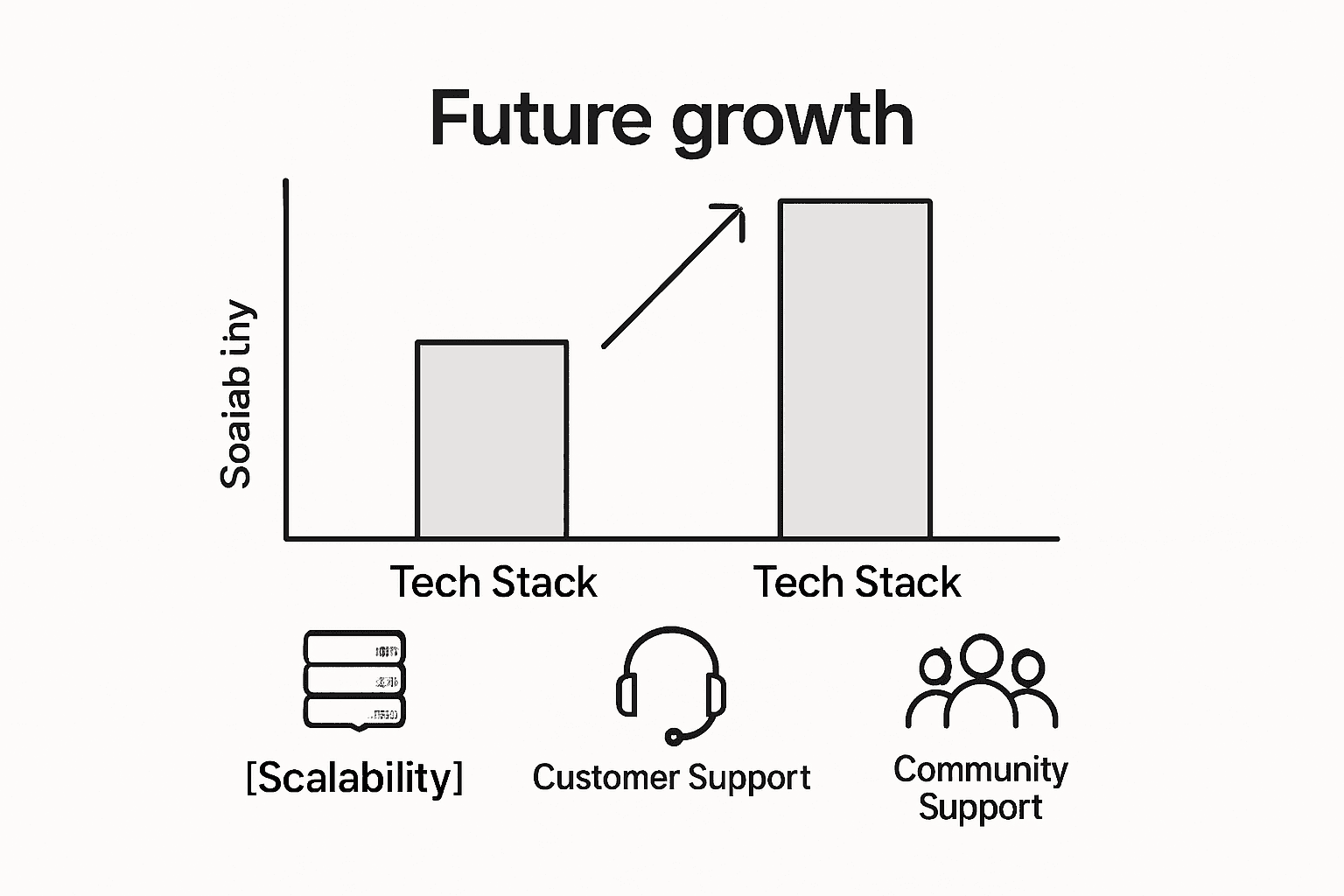
Pay close attention to community support and long term maintenance capabilities. Assess the availability of robust community networks and ongoing development resources that will support your technological ecosystem. Research the responsiveness of technology providers, availability of documentation, active developer communities, and frequency of updates. Prioritise solutions with strong ecosystem support that can provide timely troubleshooting, regular security patches, and continuous improvement mechanisms.
Pro tip: Create a comparative matrix ranking potential technologies across scalability metrics, including maximum supported user load, data processing capabilities, integration flexibility, and community support responsiveness.
Step 5: Validate tech stack with pilot testing
Pilot testing represents a crucial phase in validating your potential technological infrastructure, allowing you to thoroughly assess its performance and compatibility before full scale implementation. This strategic approach minimises risks and provides tangible insights into how your selected technologies will function within your specific business environment.
Implement pilot testing to validate the performance and reliability of your tech stack, ensuring it meets your precise business requirements. Select a small subset of your actual business processes to test the proposed technologies under realistic conditions. Choose scenarios that represent your most critical operational workflows and will expose potential limitations or strengths of the proposed solutions. During testing, document key performance metrics such as processing speed, user experience, integration capabilities, and system responsiveness.
Establish clear evaluation criteria before beginning your pilot test. Consider factors like ease of use, compatibility with existing systems, scalability potential, and alignment with your original business objectives. Engage team members from different departments to provide diverse perspectives and capture comprehensive feedback. Pay attention to both technical performance and user experience, as these elements are equally important in determining the ultimate success of your technological implementation.
Pro tip: Record detailed observations during pilot testing, including unexpected challenges, performance bottlenecks, and user interaction patterns to support an objective decision making process.
This comparison highlights common pilot testing evaluation criteria:
| Evaluation Criterion | Purpose | Example Outcome |
|---|---|---|
| User Experience | Assess usability | Faster employee adoption |
| System Performance | Measure speed and stability | Smoother daily operations |
| Integration | Check compatibility | Fewer data transfer errors |
| Scalability | Evaluate growth potential | Minimised need for upgrades |
Streamline Your Tech Stack Selection with Expertise
Choosing the ideal tech stack for an automated business can feel overwhelming as you balance scalability, integration, and compliance. The article highlights how assessing your unique workflows and piloting technologies are crucial steps to avoid costly mistakes and operational bottlenecks. If you are struggling to connect multiple systems, automate repetitive tasks, or find solutions tested in your sector, you are not alone.
At Fame Razak, we understand these challenges deeply. As a dedicated partner specialising in turning complex business operations into intelligent, automated systems, we help you focus on what matters by managing your entire tech stack strategy. Explore how our services transform client onboarding, scheduling, and workflow orchestration through AI-powered automation. Don’t let integration issues or scalability doubts slow your business down.
Take control today: Discover expert guidance and tailored solutions designed to validate and elevate your technology choices. Visit Fame Razak now and start building a tech stack that grows with your business. Learn more about how we automate operations and support seamless tech integration by visiting Fame Razak.
Frequently Asked Questions
How can I assess my business requirements for selecting a tech stack?
Begin by evaluating your business objectives and internal processes to identify specific technological needs. Create a document that tracks your assessment, focusing on workflows, compliance requirements, and areas for improvement.
What should I consider when evaluating integration and automation needs?
Focus on how different technologies can connect with your existing systems to enable seamless automation. Identify processes that are time-consuming and explore solutions that can reduce manual tasks, improving overall workflow efficiency.
How do I research proven technologies suitable for my sector?
Conduct thorough research into successful technologies used by businesses in your industry. Look for case studies and metrics that showcase the effectiveness of these solutions, and develop a comparative spreadsheet to evaluate potential options.
What factors should I compare regarding scalability and support options?
Assess how each technology can adapt to future growth and increasing operational demands. Consider factors like maximum user load and community support availability, ensuring that the technology you choose is sustainable for your business’s future needs.
How can I validate my tech stack before full implementation?
Implement a pilot test to assess the performance of your tech stack under real-world conditions. Document key metrics and gather feedback from team members to identify strengths and weaknesses, helping you make an informed decision.
What evaluation criteria should I focus on during pilot testing?
Concentrate on user experience, system performance, integration capabilities, and scalability. Establish clear evaluation criteria before testing, and observe the technology’s effectiveness in real business scenarios to support your decision-making process.