
Over 60 percent of British businesses say digital transformation is now their top priority. In a fast-changing online world, where technology shapes nearly every decision and customer interaction, British companies face new pressures and possibilities. Understanding what sets digital business strategy apart unlocks smarter ways to stay ahead, outpace global competitors, and deliver real value for both leaders and customers.
Table of Contents
- Defining Digital Business Strategy Today
- Core Types: Automation, AI, and Integration
- Key Features and Business Impact
- Costs, Risks, and Common Pitfalls
- Practical Applications for Service Providers
Key Takeaways
| Point | Details |
|---|---|
| Digital Business Strategy Definition | It is a comprehensive framework for leveraging digital technologies to transform operations and create value, requiring an integrated approach across the organisation. |
| Core Technological Domains | Successful digital transformation relies on automation, artificial intelligence, and strategic integration to enhance operational efficiency and customer experience. |
| Key Features | Modern strategies focus on adaptive technology integration, intelligent automation, data-driven decisions, scalable infrastructure, and continuous innovation. |
| Navigating Challenges | Effective implementation requires a strategic approach to risk management, addressing common pitfalls such as technological misalignment and skill gaps. |
Defining Digital Business Strategy Today
Digital business strategy represents a critical evolution in how organisations approach technological integration and competitive positioning. At its core, it is a comprehensive framework for leveraging digital technologies to transform business operations and value creation.
Unlike traditional strategic planning, digital business strategy goes beyond merely adopting new technologies. It requires a fundamental reimagining of how digital resources can be strategically deployed to create differential value. This means understanding digital not as a separate function, but as an integrated approach that touches every aspect of organisational performance. Digital strategy involves systematically leveraging technological capabilities to enhance competition, operations, and customer service.
The modern digital business strategy encompasses several critical components:
- Holistic technological integration across all business units
- Continuous adaptation to emerging digital capabilities
- Customer-centric design of digital interactions
- Data-driven decision making
- Agile organisational structures that support rapid innovation
Successful implementation demands more than technical prowess. It requires leadership vision, cultural alignment, and a willingness to challenge existing operational paradigms. Businesses must view digital strategy as an ongoing journey of transformation, not a one-time technological upgrade.
Core Types: Automation, AI, and Integration
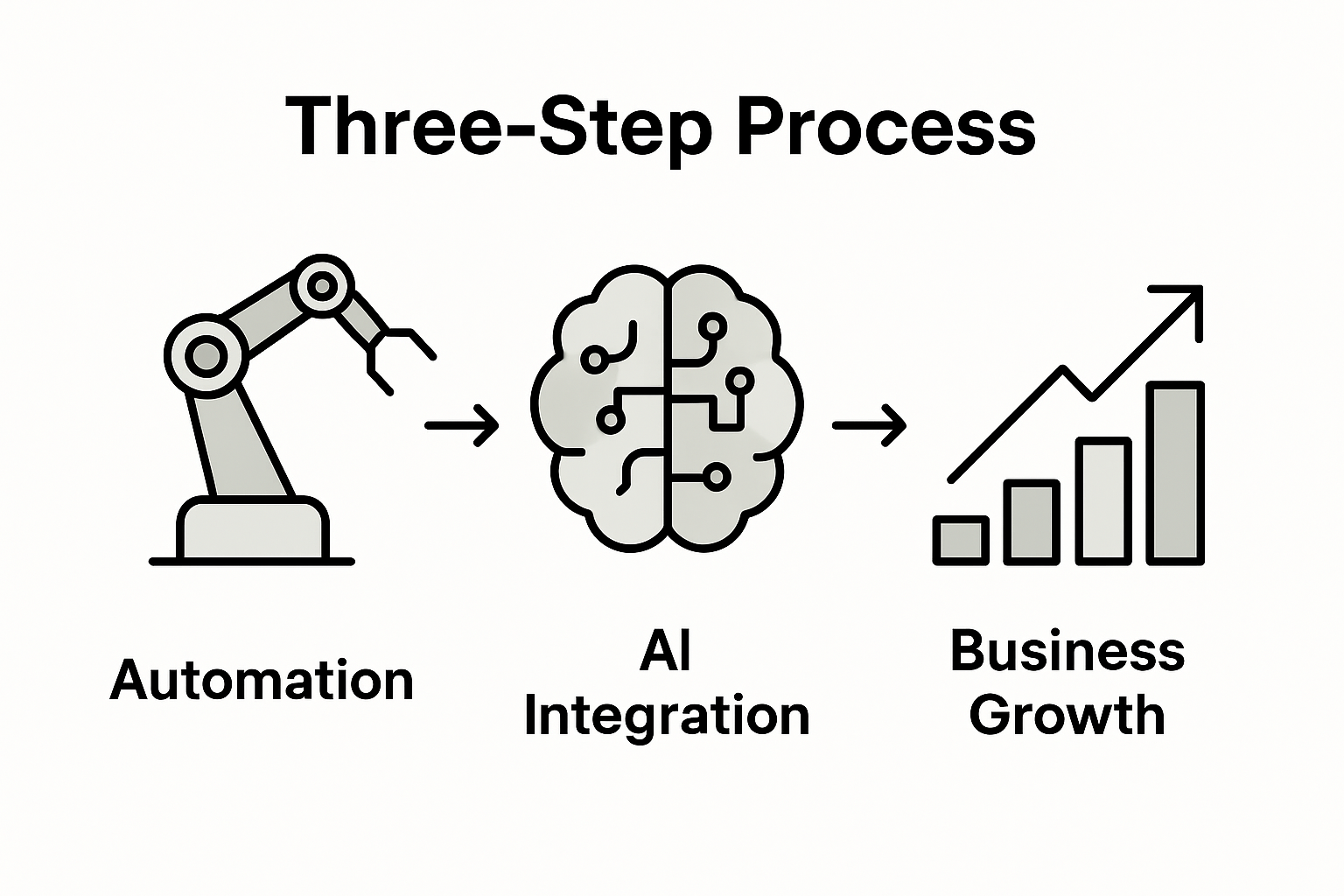
Digital business transformation increasingly relies on three interconnected technological domains: automation, artificial intelligence, and strategic integration. Hyperautomation represents a sophisticated approach that extends traditional process automation by integrating advanced AI tools with robotic process automation, enabling organisations to tackle increasingly complex operational challenges.
Artificial Intelligence (AI) plays a pivotal role in this transformation. The Enterprise AI Canvas provides a comprehensive framework for integrating AI into business operations, emphasising the critical need to identify specific use-cases where technological capabilities can generate meaningful value. This approach goes beyond mere technological implementation, focusing on fundamental organisational redesign that accommodates AI-driven processes.
The core types of digital business strategy can be understood through these key dimensions:
- Automation: Streamlining repetitive tasks and reducing manual intervention
- AI Integration: Enabling intelligent decision-making and predictive capabilities
- Strategic Systems Integration: Creating seamless technological ecosystems
Successful implementation requires a holistic approach that aligns technological capabilities with strategic business objectives. Organisations must view these technologies not as isolated tools, but as interconnected systems that can fundamentally reshape operational efficiency, customer experience, and competitive positioning.
Key Features and Business Impact
Digital business strategy fundamentally transforms organisational capabilities through advanced technological integration. DataOps provides an integrated and disciplined approach to leveraging data and analytics, enabling businesses to enhance operational efficiency and create innovative business models.

Intelligent Robotic Process Automation (RPA) represents a breakthrough in business process management, combining AI capabilities with automation to streamline high-volume routine tasks. This technological convergence allows organisations to inject intelligence into their operational workflows, dramatically reducing manual intervention and increasing overall productivity.
Key features of modern digital business strategies include:
- Adaptive Technology Integration: Seamlessly connecting disparate technological systems
- Intelligent Automation: Reducing human error and increasing operational speed
- Data-Driven Decision Making: Utilising advanced analytics for strategic insights
- Scalable Infrastructure: Creating flexible technological ecosystems
- Continuous Innovation: Maintaining technological relevance through ongoing adaptation
The business impact of these strategies extends far beyond simple efficiency gains. By embracing digital transformation, organisations can fundamentally reimagine their operational models, create new value propositions, and develop competitive advantages that were previously unimaginable. Successful implementation requires not just technological investment, but a holistic approach that aligns technological capabilities with strategic business objectives.
Costs, Risks, and Common Pitfalls
Implementing digital business strategies requires carefully navigating complex relationships between strategy content, context, and potential challenges. While digital transformation promises significant operational improvements, organisations must approach these initiatives with strategic caution and comprehensive risk assessment.
Financial investments represent one of the most significant considerations in digital strategy implementation. Technology adoption demands substantial upfront capital, with potential hidden costs including staff training, system integration, and ongoing maintenance. Effective digital business management strategies require a structured approach that transforms potential challenges into strategic opportunities, emphasising organisational flexibility and continuous innovation.
Common pitfalls organisations frequently encounter include:
- Technological Misalignment: Implementing solutions that do not integrate with existing systems
- Skill Gap: Lacking internal expertise to manage advanced technological infrastructure
- Resistance to Change: Organisational cultural barriers preventing successful adoption
- Overlooking Security Implications: Inadequate cybersecurity planning during digital transformation
- Unrealistic Expectations: Assuming immediate returns without proper implementation strategy
Successful digital strategy navigation demands a holistic approach. Organisations must balance technological investment with robust change management, continuous learning, and adaptive strategic planning. The most effective implementations view digital transformation not as a one-time project, but as an ongoing journey of technological and organisational evolution.
Practical Applications for Service Providers
Intelligent Automation (IA) programs represent a transformative approach for service providers seeking to integrate advanced AI capabilities into their operational frameworks. These sophisticated technological strategies enable organisations to reimagine traditional service delivery models, creating more efficient and responsive business ecosystems.
The integration of intelligent Robotic Process Automation (RPA) into business process management allows service providers to automate complex processes previously managed by human experts. This technological convergence enables businesses to handle increasingly sophisticated tasks with unprecedented speed and accuracy, dramatically reducing operational overhead and human error.
Practical applications across various service sectors include:
- Healthcare Services: Automating patient scheduling, medical record management, and administrative workflows
- Legal Practices: Streamlining document review, contract analysis, and client intake processes
- Financial Services: Implementing intelligent risk assessment, fraud detection, and customer onboarding systems
- Professional Consultancy: Creating automated reporting, client communication, and project management tools
- Creative Industries: Developing intelligent resource allocation and project tracking mechanisms
Successful implementation requires a strategic approach that balances technological capability with human expertise. Service providers must view intelligent automation not as a replacement for human workers, but as a powerful augmentation tool that enables professionals to focus on higher-value, more complex strategic activities.
Unlock Growth by Turning Automation into Your Business Advantage
The article highlights how digital business strategy relies on automation, AI integration, and strategic systems integration to overcome challenges like technological misalignment and resistance to change. If you are striving to streamline client onboarding, reduce manual tasks, or build a scalable, intelligent workflow that puts your business ahead of operational slowdowns, these pain points resonate deeply. Embracing a digital approach means more than adopting new tools — it requires transforming everyday operations into seamless, adaptive systems that deliver real value.
At Fame Razak, we specialise in helping small businesses and agencies overcome these exact hurdles. With expertise as a Fractional CTO grounded in agency experience, we focus on creating solutions such as AI receptionists and workflow orchestration that align perfectly with your strategic goals. Don’t let complexity stall your progress. Discover how to automate what slows you down in practical, effective ways today by visiting Fame Razak’s homepage. Take the first step now to unlock growth and work smarter with Fame Razak’s automation solutions.
Frequently Asked Questions
What is a digital business strategy?
Digital business strategy is a comprehensive framework for leveraging digital technologies to transform business operations and create differential value, integrating technology into all aspects of organisational performance.
How can automation impact my business operations?
Automation streamlines repetitive tasks, reduces manual intervention, and increases overall productivity, enabling organisations to operate more efficiently and focus on higher-value activities.
What role does artificial intelligence play in digital business strategy?
Artificial intelligence enhances decision-making, enables predictive capabilities, and supports organisational redesign, allowing businesses to utilise AI in creating impactful and intelligent processes.
What are common pitfalls when implementing a digital business strategy?
Common pitfalls include technological misalignment, skill gaps, resistance to change, inadequate cybersecurity planning, and unrealistic expectations regarding immediate returns, all of which can hinder successful implementation.
Recommended
- Business Process Digital Transformation – Boosting Real-World Efficiency – Fame Razak
- Digital Transformation Checklist for Small Businesses Success – Fame Razak
- 7 Steps to Master Digitization, Digitalization and Digital Transformation – Fame Razak
- Complete Guide to Digital Transformation in Business – Fame Razak