
Most british businesses now spend over 60 percent of their marketing budgets online, yet only a fraction truly understand the core principles that drive digital marketing success. The digital world moves quickly, and missing even one key idea can mean falling behind competitors. This guide breaks down the essential strategies every british entrepreneur needs to turn digital channels into real growth opportunities.
Table of Contents
- Core Digital Marketing Principles Explained
- Major Digital Marketing Channels Compared
- How Automation Transforms Digital Campaigns
- Essential Metrics For Measuring Success
- Common Mistakes In Digital Marketing Strategy
Key Takeaways
| Point | Details |
|---|---|
| Understand Audience Behaviour | Tailor your marketing strategies based on insights into customer preferences and behaviours. |
| Leverage Multi-Channel Approaches | Integrate various digital platforms to ensure consistent messaging and maximise engagement. |
| Implement Automation Strategically | Use automation tools to enhance campaign responsiveness and refine targeting precision. |
| Monitor Key Performance Metrics | Focus on key metrics that directly align with your business objectives for effective analytics. |
Core Digital Marketing Principles Explained
Digital marketing represents a strategic approach to connecting businesses with potential customers through online channels. The fundamental principles involve understanding audience behaviour, creating targeted content, and leveraging digital platforms effectively. Digital marketing strategies require a comprehensive understanding of how digital technologies interact with consumer psychology and brand communication.
At its core, digital marketing focuses on several key principles that differentiate it from traditional marketing. These include precise audience targeting, real-time performance measurement, personalised communication, and cost-effective engagement mechanisms. Content marketing frameworks emphasise creating valuable, relevant content that attracts and retains a clearly defined audience, moving beyond simple promotional messaging.
Successful digital marketing demands a multi-channel approach that integrates various platforms such as social media, search engines, email, and websites. Each channel requires a nuanced strategy that considers unique audience behaviours, platform algorithms, and conversion potential. Businesses must develop adaptive strategies that respond to rapidly changing digital landscapes and consumer preferences.
Pro Tip: Strategic Approach: Develop a comprehensive digital marketing plan that maps customer journeys across multiple platforms, ensuring consistent messaging and tracking performance metrics to continuously refine your approach.
Major Digital Marketing Channels Compared
Digital marketing channels represent diverse platforms through which businesses can connect with potential customers, each offering unique engagement opportunities. Integrated marketing strategies recognise the importance of selecting appropriate channels based on specific business objectives and target audience characteristics.
The primary digital marketing channels can be categorised into several key groups: search engine marketing, social media platforms, email marketing, content marketing, and paid advertising networks. Search engine marketing focuses on improving website visibility through organic search results and targeted pay-per-click campaigns. Social media platforms enable direct audience interaction, brand storytelling, and highly targeted advertising options across networks like Facebook, Instagram, LinkedIn, and Twitter.
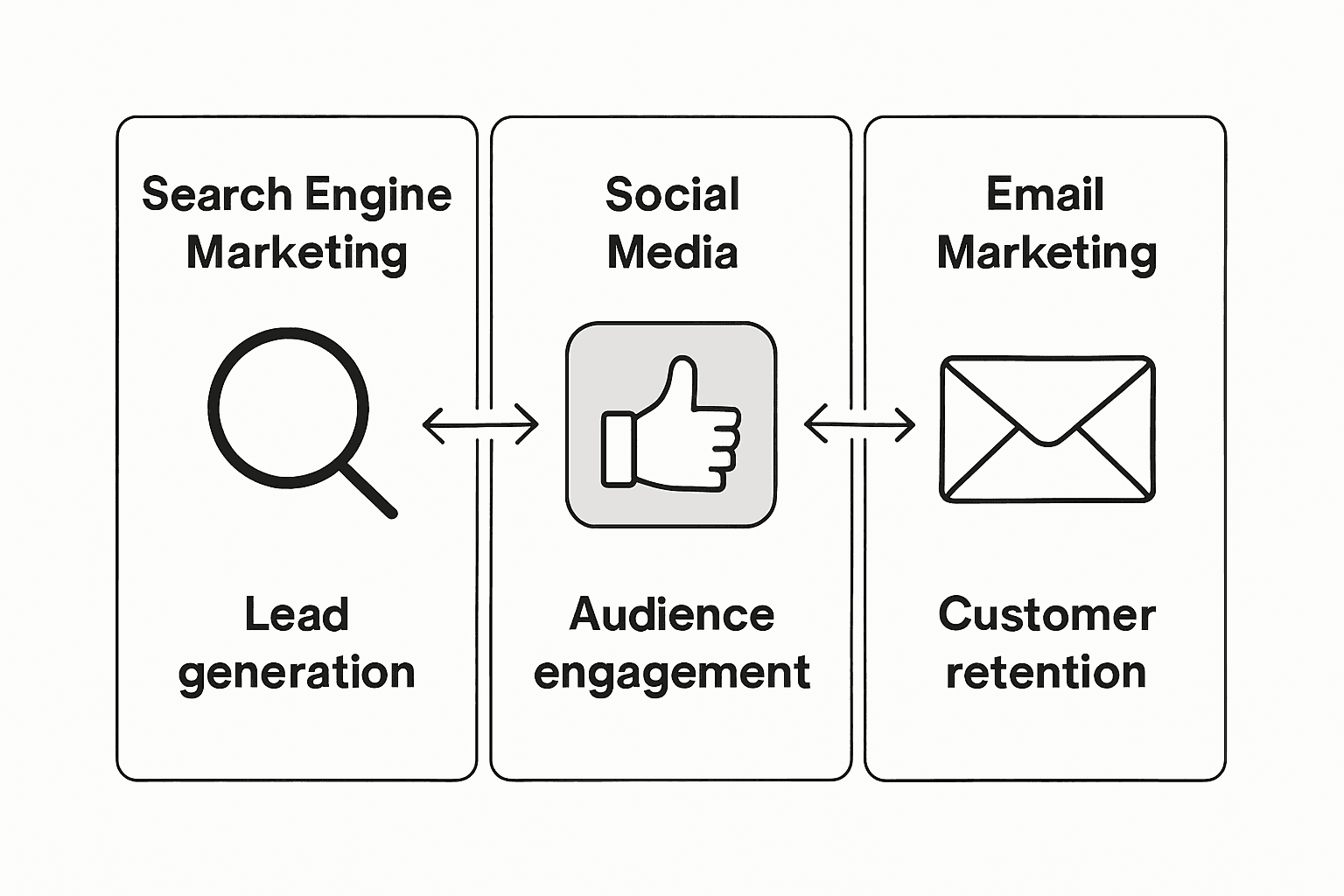
Cross-channel marketing approaches have become increasingly sophisticated, recognising that modern consumers interact with brands across multiple touchpoints. Effective strategies require seamless integration between channels, ensuring consistent messaging and tracking customer journeys from initial awareness through to conversion. Email marketing remains a powerful direct communication tool, offering personalised content delivery and measurable engagement metrics.
Here is a comparison of key digital marketing channels and their strategic advantages:
| Channel | Main Strength | Ideal Business Use |
|---|---|---|
| Search Engine Marketing | High intent targeting | Customer acquisition |
| Social Media | Brand awareness, engagement | Community building |
| Email Marketing | Personalised communication | Customer retention, updates |
| Content Marketing | Authority, trust generation | Thought leadership |
| Paid Advertising | Rapid reach, segmentation | Promotional campaigns |
Pro Tip: Channel Selection Strategy: Analyse your specific target audience’s online behaviour and preferences, then develop a multi-channel marketing approach that prioritises platforms where your ideal customers are most actively engaged.
How Automation Transforms Digital Campaigns
Automation has revolutionised digital marketing by enabling businesses to create more intelligent, responsive, and personalised campaign strategies. Neural optimization techniques are transforming how marketers approach complex customer engagement challenges, allowing for unprecedented levels of data-driven decision making and targeting precision.
The core capabilities of marketing automation encompass several critical functions: intelligent customer segmentation, personalised content delivery, real-time campaign adjustments, and comprehensive performance tracking. These systems leverage advanced algorithms to analyse customer behaviours, predict potential interactions, and dynamically adjust marketing strategies across multiple digital channels. Multi-touch attribution models have become increasingly sophisticated, helping businesses understand the nuanced interactions between different marketing touchpoints and their collective impact on customer conversion.

Modern automation platforms integrate artificial intelligence and machine learning to continuously refine marketing approaches. These technologies enable marketers to move beyond traditional static campaigns, creating adaptive strategies that respond in real-time to customer interactions, preferences, and emerging market trends. By automating repetitive tasks and providing deep analytical insights, these systems free marketing teams to focus on strategic creativity and high-value relationship building.
This summary shows how marketing automation transforms campaign effectiveness:
| Automation Feature | Business Impact |
|---|---|
| Intelligent Segmentation | Refined audience targeting |
| Personalised Content | Enhanced customer engagement |
| Real-Time Adjustments | Greater campaign responsiveness |
| Predictive Analytics | Proactive strategy refinement |
| Performance Tracking | Continuous optimisation opportunities |
Pro Tip: Automation Implementation: Start by mapping your existing marketing workflows, identifying repetitive tasks and potential bottlenecks, then progressively introduce automation tools that integrate seamlessly with your current systems and strategic objectives.
Essential Metrics for Measuring Success
Successful digital marketing hinges on understanding and tracking key performance indicators that provide meaningful insights into campaign effectiveness. Causal marketing measurement models have revolutionised how businesses evaluate their marketing strategies, enabling more precise attribution and budget allocation across different channels.
The most critical metrics for service businesses typically include conversion rate, customer acquisition cost, return on investment, engagement rate, and customer lifetime value. These metrics help organisations understand not just the immediate impact of marketing efforts, but also their long-term strategic value. Digital content marketing frameworks emphasise the importance of measuring consumer engagement, trust, and perceived value alongside traditional performance indicators.
Modern marketing analytics platforms provide sophisticated tracking capabilities that go beyond surface-level data. By integrating advanced machine learning algorithms, these systems can offer predictive insights, helping businesses anticipate customer behaviours, optimise marketing spend, and identify emerging trends before they become apparent through traditional reporting methods. This approach transforms metrics from retrospective reporting tools into forward-looking strategic assets.
Pro Tip: Metric Selection Strategy: Focus on a small set of highly relevant metrics that directly align with your specific business objectives, rather than attempting to track every possible data point, which can lead to analysis paralysis.
Common Mistakes in Digital Marketing Strategy
Content marketing research reveals that many businesses consistently undermine their digital marketing efforts through predictable strategic errors. These mistakes often stem from a fundamental misunderstanding of audience needs, technological capabilities, and strategic alignment.
One of the most prevalent errors is neglecting the consumer engagement stages defined by the AIDA model: Attention, Interest, Desire, and Action. Businesses frequently create marketing content that fails to systematically guide potential customers through these critical psychological transitions. This results in fragmented messaging, low conversion rates, and wasted marketing resources. Effective strategies require a nuanced understanding of how each piece of content must deliberately address specific stages of the customer journey.
Additional critical mistakes include poorly defined target audience parameters, inconsistent brand messaging across different digital platforms, inadequate performance tracking, and an overreliance on single marketing channels. Many service businesses mistakenly treat digital marketing as a one-size-fits-all approach, failing to recognise the unique characteristics of their specific market segment and the importance of personalised, contextually relevant communication strategies.
Pro Tip: Strategic Diagnosis: Regularly conduct a comprehensive audit of your digital marketing approach, critically examining each campaign’s performance against clear, predefined objectives and being willing to pivot quickly based on empirical data.
Unlock Efficient Digital Marketing with Intelligent Automation
Understanding key digital marketing concepts like audience targeting, multi-channel strategies and automation is only the first step for service businesses. The real challenge lies in transforming these complex principles into seamless, scalable workflows that drive measurable results. Many businesses struggle with inconsistent messaging, scattered performance tracking and manual processes that drain valuable time and resources.
Fame Razak specialises in solving exactly these challenges by automating the work that slows you down. From streamlining client onboarding and scheduling to deploying AI receptionists and intelligent workflow orchestration, our solutions bring precision and scalability to your marketing efforts. Harness the power of automation to deliver personalised content, track campaign performance continuously and respond to customer behaviour in real time.
Ready to revolutionise your digital marketing? Discover practical ways to integrate AI and automation to achieve sustainable growth and free your team for strategic creativity. Visit Fame Razak now to explore how you can turn your everyday marketing operations into an efficient, intelligent system that supports your business goals. Empower your digital marketing strategy today by learning more about automation implementation and start building smarter campaigns that truly connect.
Frequently Asked Questions
What are the core principles of digital marketing?
The core principles of digital marketing include precise audience targeting, real-time performance measurement, personalised communication, and cost-effective engagement. Understanding audience behaviour and creating targeted content are crucial for success.
How can automation enhance digital marketing campaigns?
Automation enhances digital marketing campaigns by enabling intelligent customer segmentation, personalised content delivery, real-time campaign adjustments, and comprehensive performance tracking, allowing for data-driven decision-making and campaign effectiveness.
What are the key digital marketing channels service businesses should consider?
Service businesses should consider key digital marketing channels such as search engine marketing for visibility, social media for engagement, email marketing for personalised communication, content marketing for authority, and paid advertising for rapid reach and promotional campaigns.
What common mistakes should service businesses avoid in their digital marketing strategies?
Common mistakes include neglecting the consumer engagement stages defined by the AIDA model, poorly defining target audience parameters, inconsistent messaging across platforms, inadequate performance tracking, and relying too heavily on a single marketing channel.