
Over 20 percent of website users experience barriers due to poor accessibility, affecting millions in both American and British communities. For organisations, ignoring web accessibility means not only risking legal challenges but also excluding a significant audience. Understanding ADA website compliance unlocks practical insights to help create websites that are genuinely inclusive, protect reputation, and ensure digital spaces welcome everyone, regardless of ability.
Table of Contents
- Defining ADA Website Compliance And Key Concepts
- Core Accessibility Requirements And Standards
- Practical Steps For Achieving Compliance
- Legal Obligations And Potential Risks
- Common Mistakes And How To Avoid Them
Key Takeaways
| Point | Details |
|---|---|
| Understanding ADA Compliance | ADA compliance is essential for making websites usable for individuals with disabilities, promoting inclusivity in digital spaces. |
| Implementation of Accessibility Standards | Organisations should adopt the Web Content Accessibility Guidelines (WCAG) to ensure websites are perceivable, operable, understandable, and robust. |
| Risks of Non-Compliance | Failing to comply with web accessibility laws can lead to significant financial penalties, reputational damage, and competitive disadvantages. |
| Importance of User-Centric Design | Proactive, user-centred approaches to web accessibility, including regular testing and feedback, are vital for creating truly inclusive digital experiences. |
Defining ADA Website Compliance and Key Concepts
Web accessibility is more than a technical requirement—it’s a fundamental right ensuring digital spaces are usable for everyone, including people with disabilities. The Americans with Disabilities Act (ADA) establishes clear standards for making websites inclusive and navigable for individuals with visual, auditory, motor, and cognitive impairments.
At its core, web accessibility standards require digital platforms to be perceivable, operable, understandable, and robust for all users. This means websites must provide alternative text for images, ensure keyboard navigation compatibility, maintain clear colour contrast, and support assistive technologies like screen readers. The Web Content Accessibility Guidelines (WCAG) provide a comprehensive framework that organisations can follow to create truly accessible digital experiences.
The practical implications of ADA compliance extend far beyond legal requirements. Accessible websites improve overall user experience, expand potential audience reach, and demonstrate a commitment to inclusivity. Small businesses and service providers can benefit significantly by implementing straightforward accessibility features that make their online presence welcoming to everyone, regardless of individual abilities.
Key compliance considerations include:
- Providing text alternatives for non-text content
- Creating content that can be presented in different ways
- Making websites fully operable through keyboard interfaces
- Ensuring text is readable and understandable
- Making web pages appear and operate in predictable ways
- Helping users navigate and find content effectively
Core Accessibility Requirements and Standards
Accessibility standards provide a comprehensive framework for creating digital experiences that are inclusive and usable for all individuals, regardless of their physical or cognitive abilities. European accessibility regulations have been particularly instrumental in establishing robust guidelines that ensure digital platforms are designed with universal access in mind.
The Web Content Accessibility Guidelines (WCAG) represent the gold standard for digital accessibility, offering a structured approach to creating websites that are perceivable, operable, understandable, and robust. These guidelines are organised into four primary principles that organisations must consider when developing digital content:
- Perceivable: Information and user interface components must be presentable in ways all users can perceive
- Operable: User interface and navigation must be functional for everyone
- Understandable: Content and operation must be clear and predictable
- Robust: Content must be compatible with various assistive technologies
Accessibility standards in the United Kingdom mandate that digital services meet specific conformance levels, typically targeting WCAG Level AA as the minimum acceptable standard. This means websites must implement comprehensive features such as alternative text for images, keyboard navigation support, sufficient colour contrast, and clear content structure that supports screen readers and other assistive technologies.

Implementing these standards is not just a legal requirement but a fundamental approach to creating inclusive digital experiences. By adopting these guidelines, organisations demonstrate a commitment to providing equal access and opportunities for all users, regardless of their individual capabilities.
Practical Steps for Achieving Compliance
Navigating web accessibility requires a structured approach that systematically addresses potential barriers for users with disabilities. Guidance from the U.S. Department of Justice emphasises the importance of implementing comprehensive accessibility strategies that go beyond mere technical compliance.
Key practical steps for achieving ADA website compliance include:
- Conduct a Comprehensive Accessibility Audit
- Evaluate current website design and functionality
- Identify potential accessibility barriers
- Document existing gaps in user experience
- Implement Visual Design Considerations
- Ensure sufficient colour contrast for readability
- Provide alternative text for images and visual content
- Design with clear, predictable navigation structures
- Enhance Technical Accessibility
- Make website fully keyboard navigable
- Ensure compatibility with screen readers
- Provide text alternatives for non-text content
UK accessibility guidelines recommend developing a structured approach that systematically addresses potential user interaction challenges. This involves creating clear hierarchical content structures, using semantic HTML, and ensuring that interactive elements are clearly defined and easily operable.
Successful compliance is not a one-time achievement but an ongoing commitment to inclusive digital design. Regular testing, user feedback, and continuous improvement are essential to maintaining an accessible website that serves all users effectively.
Legal Obligations and Potential Risks
Web accessibility legislation represents a critical legal framework that mandates organisations to provide digital experiences accessible to individuals with disabilities. The Americans with Disabilities Act (ADA) establishes clear expectations for digital platforms, transforming web accessibility from a recommended practice to a legal requirement.
The potential risks of non-compliance are substantial and multifaceted:
-
Financial Penalties
- Substantial legal fines
- Potential court-ordered remediation costs
- Significant legal defence expenses
-
Reputational Damage
- Negative public perception
- Loss of customer trust
- Potential brand reputation erosion
-
Competitive Disadvantage
- Reduced market reach
- Exclusion of potential customers
- Limited digital engagement opportunities
The Twenty-First Century Communications and Video Accessibility Act underscores the growing legal emphasis on digital inclusivity, highlighting that accessibility is no longer optional but a fundamental requirement for organisations operating in the digital landscape.
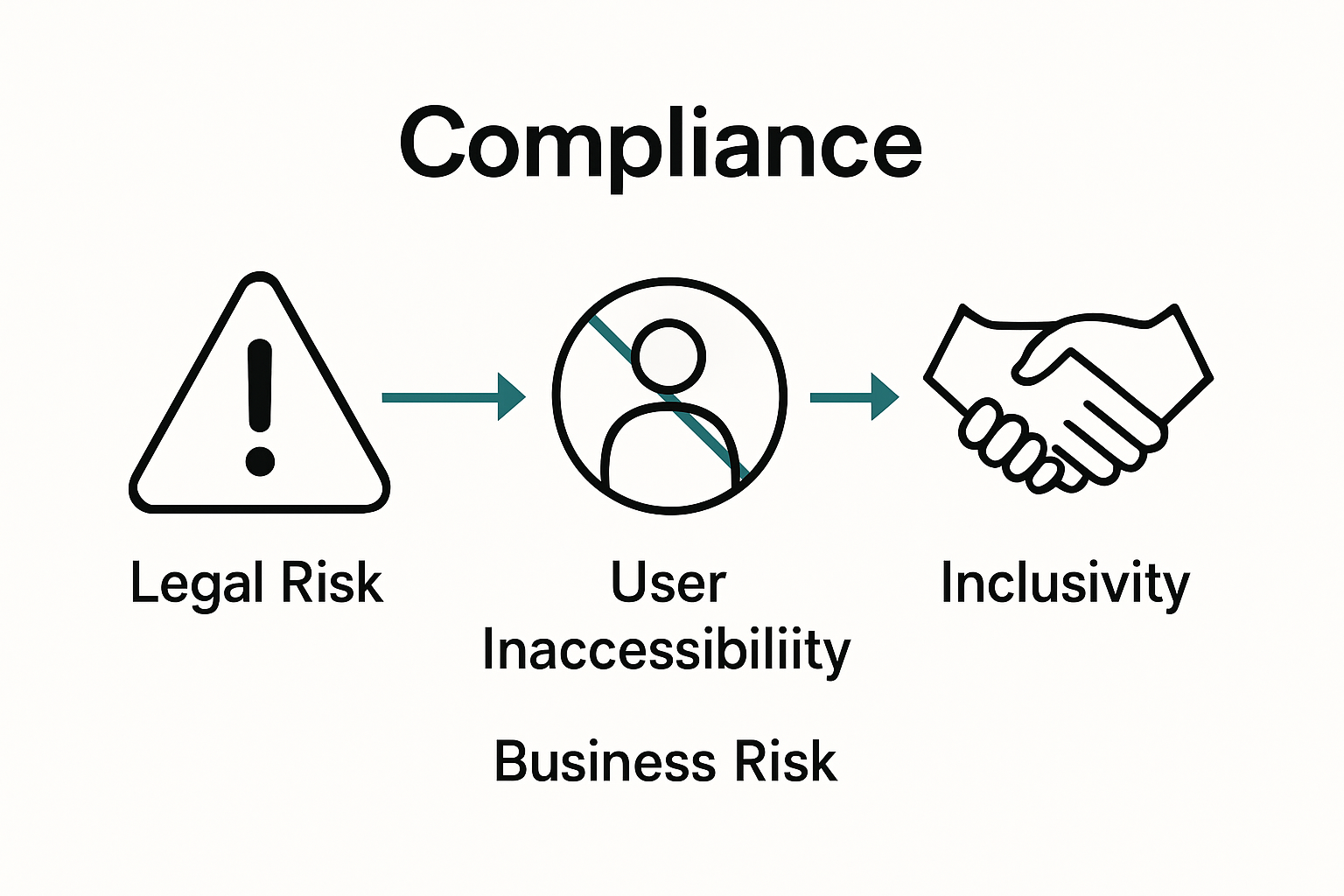
Businesses must recognise that web accessibility compliance is not merely a legal checkbox but a fundamental commitment to inclusive digital experiences. Proactive implementation of accessibility standards demonstrates organisational integrity, mitigates legal risks, and creates genuine value for all users, regardless of their individual abilities.
Common Mistakes and How to Avoid Them
Contemporary accessibility research highlights the critical importance of moving beyond mere technical compliance to creating genuinely inclusive digital experiences. Web accessibility is not a simple checklist but a comprehensive approach to understanding and addressing diverse user needs.
The most frequent accessibility mistakes organisations encounter include:
-
Inadequate Alternative Text
- Providing non-descriptive image descriptions
- Omitting crucial contextual information
- Failing to capture image meaning for screen reader users
-
Poor Colour Contrast
- Using low-contrast colour schemes
- Ignoring readability for visually impaired users
- Relying solely on colour to convey information
-
Complex Navigation Structures
- Creating inconsistent menu layouts
- Lacking clear keyboard navigation paths
- Designing non-intuitive interaction flows
Compliance guidance from the U.S. Department of Justice emphasises that accessibility is fundamentally about creating digital environments that accommodate diverse user capabilities. This means thinking beyond technical requirements and focusing on genuine user experience.
Successful web accessibility demands a proactive, user-centred approach. Regular testing with actual users with disabilities, continuous learning, and an ongoing commitment to inclusive design are essential strategies for developing truly accessible digital platforms.
Streamline Your ADA Website Compliance Journey with Automation
Ensuring your website meets ADA compliance is a crucial step to avoid legal risks and provide an inclusive experience for all users. The challenge lies in implementing complex standards like WCAG while maintaining efficient workflows and a seamless user experience. Common pain points include navigating technical accessibility requirements, managing ongoing audits, and adapting content for diverse user needs.
At Fame Razak, we understand these obstacles and specialise in automating the tasks that slow you down. By leveraging intelligent systems for client onboarding, scheduling, and workflow orchestration, we help small businesses and agencies focus on meaningful improvements rather than manual compliance efforts. Discover practical ways to integrate AI-driven solutions that support your commitment to accessibility and inclusivity with our expert guidance at Fame Razak.
Ready to transform your accessibility strategy into a scalable, efficient process? Explore how our automation expertise can reduce compliance burdens and enhance your digital presence today. Visit Fame Razak to learn more and take the next step toward a fully accessible and future-proof website.
Frequently Asked Questions
What is ADA website compliance?
ADA website compliance refers to the adherence to the Americans with Disabilities Act (ADA), which mandates that digital platforms must be accessible to individuals with disabilities, ensuring an inclusive web experience.
What are the key principles of the Web Content Accessibility Guidelines (WCAG)?
The key principles of the WCAG are Perceivable, Operable, Understandable, and Robust, which guide organisations in making their web content accessible to all users, including those with disabilities.
How can I conduct a comprehensive accessibility audit for my website?
To conduct an accessibility audit, evaluate your current website design and functionality, identify any accessibility barriers, and document gaps in user experience that prevent users with disabilities from accessing your content effectively.
What are the potential risks of non-compliance with web accessibility legislation?
Non-compliance can lead to financial penalties, reputational damage, and competitive disadvantages, including legal fines, loss of customer trust, and reduced market reach.
Recommended
- Website Compliance Checklist: Complete Guide for 2025 – Fame Razak
- Compliance Checklist for Global Sites: Step-by-Step Guide – Fame Razak
- Understanding the Website Accessibility Checklist – Fame Razak
- Web Accessibility Explained: Benefits, Standards, Compliance – Fame Razak
- 8 Essential Restaurant Safety Checklists for Success – Probe IT